






















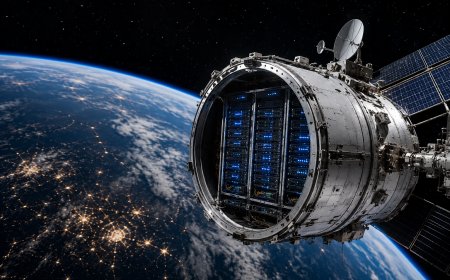











Pacific Fusion unveils prototype capable of delivering 440-gigawatt pulses in 80 nanoseconds
Pacific Fusion has revealed a new prototype capable of producing 440 gigawatts in an 80-nanosecond burst, marking a significant step toward commercial fusion energy.
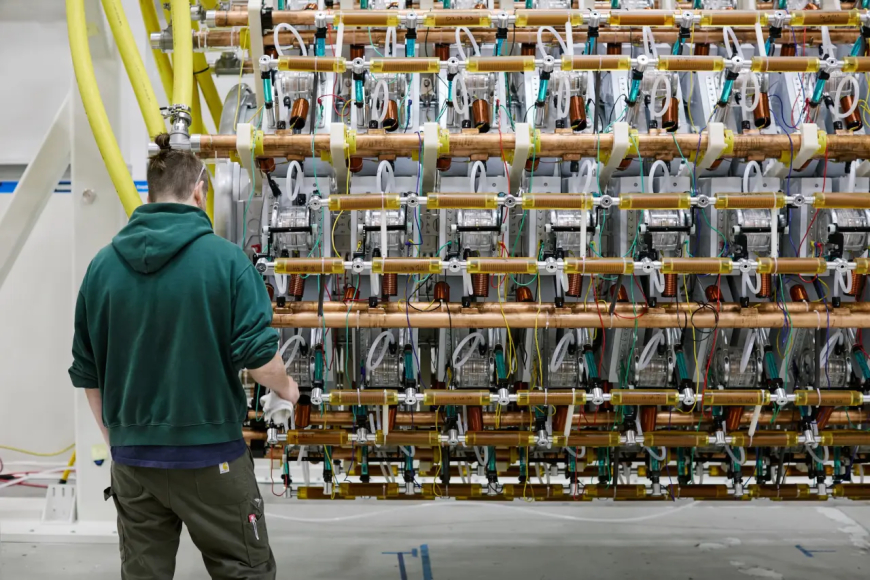
Fusion energy startup Pacific Fusion unveiled its latest pulser module prototype on Tuesday, marking an important step toward developing its planned demonstration fusion facility. The newly revealed system is a key component in the company’s fusion technology roadmap, and construction of the demonstration facility is expected to begin later this summer.
According to the company, the performance of the shipping-container-sized prototype was strong enough to unlock an additional tranche of funding from Pacific Fusion’s Series A round, which now exceeds $1 billion in total commitments. While the company did not disclose the size of the newly released funding portion, Pacific Fusion remains one of the most heavily funded startups in the fusion energy sector.
The tranche-based funding structure is more commonly seen in biotechnology companies, where investors release capital as startups achieve predefined technical milestones. This approach allows companies to spend less time fundraising and more time on research, engineering, and development.
Pacific Fusion Chief Technology Officer Keith LeChien said the arrangement has enabled the company to remain focused on execution.
“The funding structure lets us keep our heads down,” LeChien said. “It means that we can lean into the future without spending 20% to 50% of our time constantly looking for the next piece of capital.”
Pacific Fusion is pursuing a fusion energy approach known as inertial confinement fusion. Its planned reactor design will employ 156 pulser modules to deliver a massive burst of electrical energy into a tiny fuel target located inside a fusion chamber. That pulse of electricity is intended to generate a powerful magnetic field around a fuel pellet roughly the size of an eraser, compressing it until atomic nuclei fuse and release substantial amounts of energy.
The company’s next major objective will be scaling the current prototype into a full-size pulser module, which will serve as the central building block of the demonstration facility. Pacific Fusion hopes the completed facility will ultimately generate more energy than it consumes during operation, a milestone that has yet to be achieved by any fusion energy company.
Despite the technical challenges that remain, the company is moving ahead with facility construction before completing tests on a full-scale pulser module. With competition across the fusion industry intensifying, Pacific Fusion is accelerating its timeline.
“The shovels go in the ground for that facility this summer,” LeChien said.
At present, inertial confinement remains the only fusion method that has successfully produced a controlled fusion reaction generating more energy than was required to initiate it, a benchmark commonly referred to as scientific breakeven. To date, only one facility has repeatedly demonstrated that achievement: the National Ignition Facility at Lawrence Livermore National Laboratory.
However, Pacific Fusion’s approach differs significantly from that used at the National Ignition Facility. While NIF relies on large, expensive laser systems to drive fusion reactions, Pacific Fusion aims to achieve similar results using thousands of comparatively low-cost electrical switches and capacitors. These components will work together to create extremely powerful electrical pulses lasting approximately 100 nanoseconds each.
One of the company’s primary engineering challenges involves ensuring that every capacitor discharges at precisely the right moment. Any timing inaccuracies could prevent the fuel pellet from receiving enough energy quickly enough to achieve the compression required for a fusion reaction.
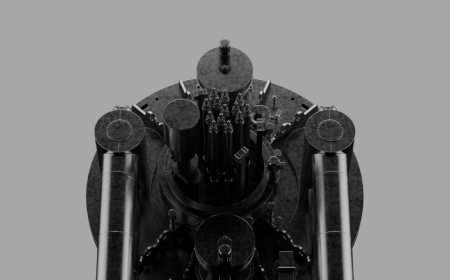
The demonstration system will eventually consist of 156 full-size pulser modules. Each module is designed to contain 32 circular stages, with every stage surrounded by 10 individual bricks. Each brick houses two capacitors for storing electrical energy and a single switch that releases that energy at exactly the right time.
The recently tested prototype represents roughly one-third of the size of a full-scale module. It comprises nine stages and 90 bricks. During testing, the system successfully generated a peak power output of 440 gigawatts within a pulse lasting only 80 nanoseconds.
According to LeChien, the results met all of the company’s performance requirements to move forward with larger-scale development. “It meets all our requirements for scaling up to build our big demonstration system,” he said.
Once the demonstration facility is operational, Pacific Fusion intends to move beyond simply achieving scientific breakeven. The company’s ultimate objective is to reach facility breakeven, a milestone where the fusion system produces enough energy to power the entire facility in which it operates.
LeChien emphasised that this benchmark represents the next major challenge for every fusion company, regardless of its specific technological approach. “Any fusion approach, regardless of your specific technology, has to traverse through that,” he said. “It’s the next tectonic milestone in fusion.”
What's Your Reaction?
 Like
0
Like
0
 Dislike
0
Dislike
0
 Love
0
Love
0
 Funny
0
Funny
0
 Angry
0
Angry
0
 Sad
0
Sad
0
 Wow
0
Wow
0