







































Nvidia DLSS 5 Brings Subtler Visuals to Hogwarts Legacy on November 5
Nvidia DLSS 5 arrives in Hogwarts Legacy on November 5 with more restrained visual changes and an updated AI rendering model designed to reduce GPU overhead.
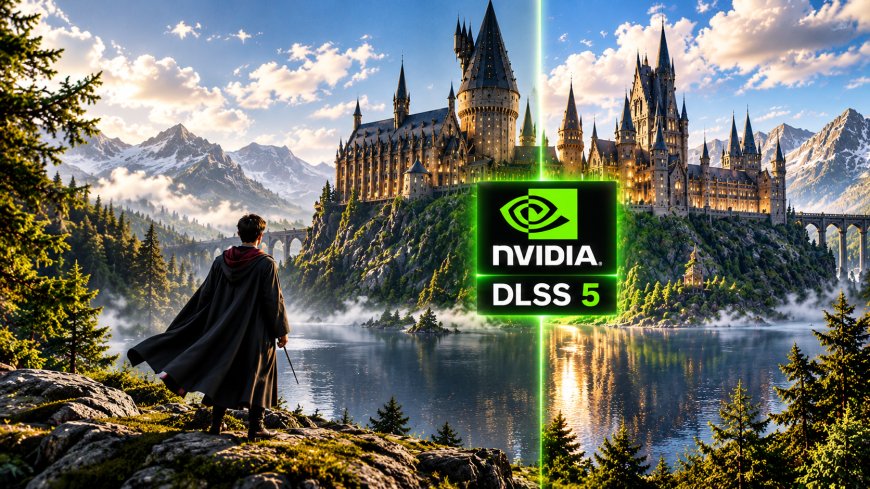
Nvidia is bringing DLSS 5 to Hogwarts Legacy on November 5, 2026, with a more restrained approach to AI-generated visual enhancements. The update follows criticism of early demonstrations in which the technology noticeably changed character appearances, raising concerns about how artificial intelligence could affect a game’s original art direction.
The new implementation appears considerably less aggressive. Nvidia’s latest comparison images show subtler adjustments to facial details, lighting, and environmental materials, suggesting Avalanche Software prioritised preserving the game’s existing visual identity.
Hogwarts Legacy Gets a More Refined Version of DLSS 5
DLSS 5 introduces 3D-Guided Neural Rendering, which uses artificial intelligence to enhance lighting and material details in frames produced by a game’s rendering engine. Unlike conventional DLSS upscaling and frame generation, the technology can change how surfaces, shadows, skin and other visual elements appear.
Earlier demonstrations attracted criticism because some characters looked substantially different from their original designs. The latest Hogwarts Legacy comparisons show a more conservative implementation, particularly around faces. Environmental improvements also appear more measured, emphasising lighting and surface detail rather than dramatic changes to the overall image.
Nvidia says developers retain control over how neural rendering affects individual elements. Its DLSS 5 developer controls include adjustments for structural detail, lighting tone, and selective masking, letting studios limit enhancements to specific objects or areas of a scene.
Avalanche Software has used these controls to maintain Hogwarts Legacy’s artistic style. That distinction matters because greater photorealism doesn’t automatically produce a better image, especially when AI enhancements alter recognisable characters or deliberately stylised environments.
Nvidia Reduces the Performance Cost of Neural Rendering
Visual changes are only part of the update. Nvidia has also introduced a more efficient neural rendering model designed to reduce the processing demands of DLSS 5.
According to Nvidia’s October 13 announcement, the revised model delivers twice the processing performance of its September version. The company reduced its parameter count by 24% to about 118 million and cut video memory use at 4K resolution by 20%.
Those improvements reduce GPU overhead for neural rendering while maintaining comparable visual quality, according to Nvidia. However, the company has not published specific Hogwarts Legacy frame-rate results for the upcoming implementation, so its actual performance impact remains unconfirmed.
The optimised model will arrive in NBA 2K27 on October 16 before appearing in future DLSS 5-supported games. Hogwarts Legacy will receive the technology on November 5 for GeForce RTX 50 Series hardware, GeForce NOW and RTX Spark. The update will also bring newer versions of the game’s existing DLSS technologies.
Additional DLSS Updates Are Coming
Nvidia is separately testing a faster Frame Generation performance mode through its Nvidia app beta. Available for supported RTX 40 Series and RTX 50 Series GPUs, the mode uses a lighter algorithm to reduce processing overhead, although Nvidia acknowledges minor image-quality trade-offs.
The company reports that the new mode can deliver up to 35% faster Frame Generation processing on an RTX 5060. This is a separate improvement from DLSS 5 neural rendering and should not be interpreted as a guaranteed frame-rate increase in Hogwarts Legacy.
DLSS 5 support is also scheduled for Where Winds Meet in late November, while Nvidia plans to introduce the technology to its RTX Remix modding platform on October 23.
What the Update Means for PC Gamers
The Hogwarts Legacy update offers an important test of whether AI-powered graphics can improve visual realism without compromising a game’s established appearance. Nvidia’s latest comparisons suggest progress in that direction, although the final results will depend on how the technology performs during actual gameplay.
For compatible RTX 50 Series owners, the November update provides another opportunity to evaluate neural rendering beyond its initial implementation in NBA 2K27. Players who prefer the original art direction can also keep DLSS Neural Rendering disabled.
The most encouraging development is not simply that DLSS 5 has become faster. It is that the technology appears to be moving toward a more selective approach, where improvements to lighting and materials support the developer’s visual design rather than competing with it.
What's Your Reaction?
 Like
0
Like
0
 Dislike
0
Dislike
0
 Love
0
Love
0
 Funny
0
Funny
0
 Angry
0
Angry
0
 Sad
0
Sad
0
 Wow
0
Wow
0