






































AI Heart Disease Prediction: How Artificial Intelligence Is Changing Cardiovascular Care
AI heart disease prediction helps healthcare companies analyse ECGs, imaging, and wearable data to support earlier detection of cardiovascular risk.
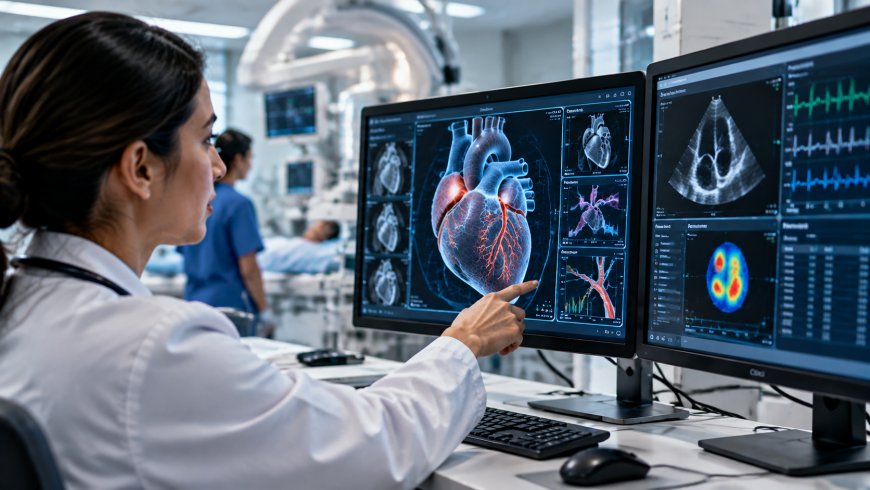
Heart disease remains one of the biggest challenges in global healthcare, but artificial intelligence is creating new ways for doctors to understand cardiovascular risks before serious problems occur.
For decades, cardiovascular care has depended on traditional measurements such as blood pressure, cholesterol levels, imaging tests and patient history. These methods remain essential, but researchers and healthcare companies are now exploring whether AI can identify additional patterns hidden inside medical data.
AI heart disease prediction does not aim to replace cardiologists.
Instead, the goal is to help doctors analyse more information, recognise potential risks earlier and make better-informed decisions.
AI systems are now being developed to study electrocardiograms (ECGs), cardiac imaging, wearable-device data and electronic health records. By combining these sources, companies are attempting to build tools that can support earlier detection and more personalised cardiovascular care.
Why Heart Disease Is Becoming a Major AI Focus
Cardiovascular disease generates enormous amounts of medical data.
Every heartbeat produces measurable signals. Medical imaging reveals changes in heart structure. Wearable devices continuously collect information about activity and heart rhythm.
The challenge is that much of this information is complex and difficult to analyse together.
Machine-learning models can process large datasets and search for relationships that may not be obvious through traditional analysis.
For example, an AI system trained on thousands of ECG recordings may identify subtle patterns linked to future cardiovascular risk.
That does not mean AI can predict every heart problem.
Healthcare decisions still require clinical evaluation, patient history and physician judgment.
But AI can provide another layer of analysis.
AI Is Expanding the Role of ECG Testing
The electrocardiogram is one of the most common tools used in heart care.
An ECG records the heart’s electrical activity and helps physicians identify rhythm abnormalities.
AI is expanding what researchers can do with ECG data.
Instead of looking only for obvious rhythm problems, newer AI models are being trained to detect more complex patterns that may be associated with cardiovascular conditions.
This has created interest in AI-powered ECG analysis because ECG tests are already widely available, relatively inexpensive and easy to perform.
Companies are exploring whether AI can extract additional information from existing heart signals without requiring completely new medical procedures.
AliveCor Is Bringing AI Into Personal Heart Monitoring
One company focused on AI-powered cardiac monitoring is AliveCor.
The company develops portable ECG devices that let users record heart activity outside traditional healthcare settings.
Its Kardia platform uses artificial intelligence algorithms to analyse ECG recordings and identify certain heart rhythm patterns.
Read AliveCor’s technology information.
The growth of AI-powered ECG devices reflects a larger healthcare trend.
Instead of collecting health information only during occasional medical appointments, connected devices are creating continuous streams of patient data.
The challenge is determining which signals are clinically meaningful.
A change in heart rate does not always indicate a medical problem. AI systems need to separate normal variation from patterns that may require further evaluation.
HeartFlow Uses AI to Analyse Coronary Arteries
Cardiac imaging is another area where AI is gaining attention.
HeartFlow developed an AI-based platform that analyses coronary CT angiography scans to create a personalised digital model of a patient’s coronary arteries.
The technology is designed to help physicians better understand coronary artery disease by providing additional analysis from existing CT imaging data.
Read HeartFlow’s technology information
Traditional CT images show the structure of coronary arteries.
AI-based analysis can add additional information by processing the scan and creating computational models that help clinicians evaluate blood flow-related factors.
The system does not replace a cardiologist’s interpretation.
Instead, it provides additional information that can support clinical decisions.
Wearable Devices Are Creating New Cardiovascular Data
The rise of smartwatches and wearable health devices has created another opportunity for cardiovascular AI.
Devices from companies such as Apple and others can collect information including heart rate, activity levels and, in some cases, ECG recordings.
Apple has introduced health features such as irregular rhythm notifications and ECG capabilities on supported Apple Watch models.
Apple Health technology information
The challenge is moving from consumer data collection to medical value.
A wearable device can collect millions of measurements, but healthcare professionals need reliable systems that explain which changes matter and which do not.
AI may help analyse these large datasets and identify patterns that deserve attention.
Predictive AI Could Support Preventive Heart Care
One of the biggest reasons healthcare companies are investing in cardiovascular AI is the possibility of earlier intervention.
Many cardiovascular conditions develop gradually.
A patient may not experience obvious symptoms until a disease has progressed significantly.
AI-based risk prediction could help identify patients who may benefit from closer monitoring, additional testing or earlier lifestyle and treatment changes.
This approach fits into a broader movement toward preventive healthcare.
Instead of focusing only on treating disease after it appears, healthcare systems are increasingly looking for ways to identify risk earlier.
The Challenge Is Proving AI Improves Patient Outcomes
Despite the rapid growth of AI healthcare technology, prediction alone is not enough.
A successful cardiovascular AI system must demonstrate that its predictions lead to better decisions and improved patient outcomes.
Healthcare organisations also need to consider:
- Accuracy across different populations
- False alerts
- Data privacy
- Integration with clinical systems
- Regulatory requirements
A model that performs well in research conditions may face new challenges when used across different hospitals and patient groups.
That is why clinical validation remains one of the most important steps in adopting healthcare AI.
The Future of AI in Cardiovascular Medicine
AI in heart care is developing across several areas at once.
Some systems analyse ECG signals.
Others process cardiac imaging.
Wearable devices are creating new sources of continuous health information.
Together, these technologies are changing how researchers and companies approach cardiovascular risk.
The future of AI heart disease prediction is unlikely to involve replacing cardiologists.
Instead, the technology is expected to work alongside healthcare professionals by helping them review more information, identify possible risks earlier and make more informed decisions.
As healthcare becomes increasingly digital, cardiovascular care may become one of the most important areas where AI moves from research into everyday medical practice.
What's Your Reaction?
 Like
0
Like
0
 Dislike
0
Dislike
0
 Love
0
Love
0
 Funny
0
Funny
0
 Angry
0
Angry
0
 Sad
0
Sad
0
 Wow
0
Wow
0