

































Epic Games Delays Disney Shooter as Developers Shift to AI-Generated Code and Art
Epic Games reportedly delays its Disney shooter as developers shift to AI-generated code and artwork, with Anthropic’s Claude among the tools involved.
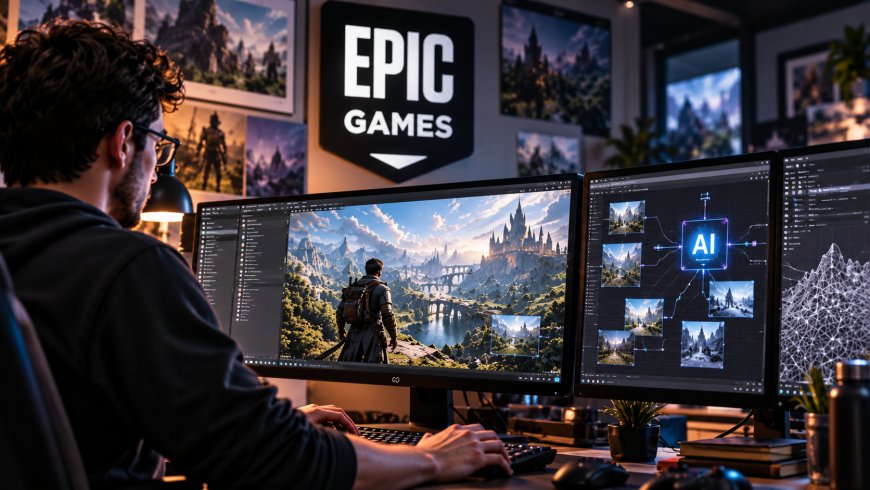
Epic Games has reportedly delayed an upcoming Disney shooter featuring Marvel and Star Wars characters while directing its development team to rely heavily on artificial intelligence for programming and artwork. The unannounced game was originally expected in March 2027, but Epic has not communicated a replacement release date.
The decision marks a significant shift in how Fortnite’s developer approaches game production. According to rloomberg’ reporterJason Schreier, Epic has instructed the project’s developers to adopt an AI-first workflow, using tools including Anthropic’s Claude to generate code while human staff supervise and refine the results.
Epic Games Pushes AI-Generated Code and Artwork
The new directive goes beyond using artificial intelligence for occasional programming assistance. Developers were reportedly instructed to stop writing code manually, while AI-driven production workflows would create the game’s artwork. Human developers would remain responsible for directing, reviewing and managing the generated material.
The instructions reportedly surprised some employees, who questioned whether AI-generated code and artwork could meet the project’s requirements. Some developers raised concerns about the approach’s reliability and whether it would deliver the productivity improvements management expected.
Epic Games communications director Jake Jones confirmed that the company is adopting AI-accelerated development, emphasising that human developers remain responsible for creative direction. However, Epic has not publicly demonstrated how the new workflow will operate on the Disney project or how much of the finished game will ultimately be AI-generated.
Tim Sweeney Confirms a Company-Wide AI Shift
Epic Games CEO Tim Sweeney has acknowledged that the company is making a broader transition toward AI-assisted development. In an October 12 statement, Sweeney said Epic was reorganising development resources to accelerate AI adoption, aiming to help teams produce more content and improve development efficiency.
Sweeney argued that the objective was not to accomplish the same work with fewer employees. He also indicated that the benefits could extend to developers using Unreal Engine, suggesting Epic’s AI strategy reaches beyond its internally developed games.
The shift comes months after Epic announced more than 1,000 job cuts in March 2026. In its official announcement, the company attributed those reductions to declining Fortnite engagement and financial pressures, and explicitly stated the layoffs were unrelated to AI.
Disney’s $1.5 Billion Partnership Faces a Development Delay
The delayed shooter is part of Epic Games’ larger relationship with Disney. In February 2024, the companies announced a multiyear collaboration to develop a connected gaming and entertainment universe powered by Unreal Engine. Disney also committed $1.5 billion to acquire an equity stake in Epic Games.
The original partnership announcement outlined plans for experiences involving Disney, Pixar, Marvel, Star Wars, and Avatar properties, letting players interact with familiar characters and create their own experiences in a persistent digital environment.
The upcoming shooter has not been formally unveiled, and details of its reported gameplay remain limited. Bloomberg reported that development had progressed more slowly than expected, partly because Epic underestimated the staffing and time required to complete the project.
Although the AI-first directive introduces a major production change, no evidence suggests generative AI will resolve those scheduling problems. Epic has not provided a revised launch window or disclosed how the new approach will affect development costs.
What Epic’s AI Strategy Means for Game Development
Generative AI is already being used in game development for programming assistance, prototyping and asset creation. Epic’s reported instructions represent a broader commitment, potentially moving AI from a supporting tool to a central role in producing a major commercial game.
That raises practical questions about code reliability, artistic consistency and quality control. A large shooter built around recognisable Disney franchises must maintain consistent gameplay systems, visual design and character presentation. Human supervision remains essential, particularly when AI-generated outputs require correction or substantial revision.
Epic’s strategy also highlights the growing tension between development efficiency and creative control. AI tools may speed up certain production tasks, but the company has yet to show that an AI-first workflow can deliver a finished game faster without sacrificing quality.
For now, the Disney shooter remains delayed, and its new development process is still an unproven approach at this scale. The project’s eventual release could offer an important test of whether generative AI can meaningfully improve major game production rather than simply changing how developers carry out their work.
What's Your Reaction?
 Like
0
Like
0
 Dislike
0
Dislike
0
 Love
0
Love
0
 Funny
0
Funny
0
 Angry
0
Angry
0
 Sad
0
Sad
0
 Wow
0
Wow
0