



































Firefox Keeps uBlock Origin Alive as Chrome and Edge Move On
Firefox keeps full uBlock Origin support as Chrome moves beyond Manifest V2, giving users another option for powerful ad blocking and privacy controls.
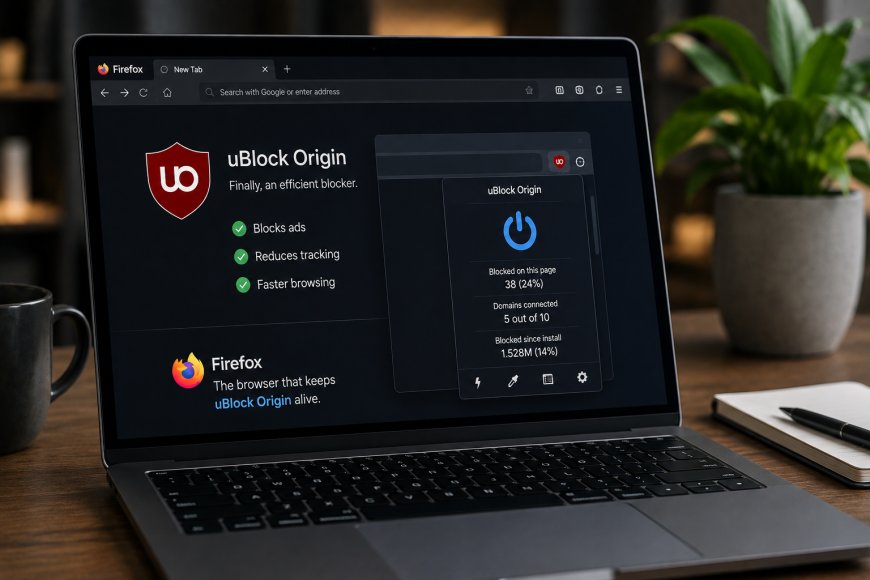
Mozilla Firefox is emerging as one of the remaining major browsers where users can continue to run the full version of uBlock Origin, as Google Chrome and Microsoft Edge move away from the older extension technology that the popular ad blocker relies on.
The divide centres on Manifest V2, an older browser extension framework that Google has been replacing with Manifest V3 in Chromium.
Mozilla has taken a different path. Firefox supports Manifest V3 but has chosen to retain important capabilities used by powerful content-blocking extensions, including the blockingWebRequest API.
That decision means Firefox users can continue using the full uBlock Origin extension rather than being forced onto a more limited alternative.
Why uBlock Origin Is Different on Firefox
uBlock Origin is a free, open-source content blocker developed by Raymond Hill. It can block advertising, trackers and other unwanted network requests using customizable filtering rules.
The extension has historically relied on capabilities available through Manifest V2.
Google's transition toward Manifest V3 changed how extensions intercept and modify network requests in Chrome. One important difference involves replacing the older blocking approach with the declarativeNetRequest system.
Mozilla has implemented Manifest V3 without abandoning the blocking capabilities that extensions such as uBlock Origin use.
"Firefox is keeping it alongside Manifest V3," Mozilla says in its explanation of the company's extension strategy.
The company argues that its approach gives extension developers greater flexibility and users more control over their browsing experience.
Full uBlock Origin Remains Available on Firefox
This is not simply a promise about future compatibility.
Mozilla’s official Firefox Add-ons repository continues to host the full uBlock Origin extension. Recent versions support Firefox on desktop and Android.
That puts Firefox in a noticeably different position from Chrome as the browser-extension ecosystem completes its transition away from Manifest V2.
Google's changes do not mean ad blocking has disappeared; from Google, Manifest V3-compatible content blockers remain available, including uBlock Origin Lite.
However, uBlock Origin Lite and the original uBlock Origin are not identical products. The Lite version was specifically designed around the restrictions and capabilities of Manifest V3.
For users who want the original extension and its broader filtering controls, browser choice has therefore become increasingly important.
Microsoft Edge Is Moving in the Same Direction
Microsoft Edge is also based on Chromium and has been moving toward removing support for Manifest V2 extensions.
That means Edge users face many of the same compatibility changes affecting Chrome users.
Firefox is technically different because it uses Mozilla's own Gecko browser engine rather than Chromium.
That independence allows Mozilla to make different decisions about extension APIs instead of automatically following Google's implementation.
Brave, despite being Chromium-based, has taken steps to preserve access to selected Manifest V2 extensions, including uBlock Origin.
Browser Extensions Are Becoming a Competitive Feature
For years, browser competition largely focused on speed, memory consumption, security and compatibility.
Extension policies are now becoming another reason users may choose one browser over another.
Google has argued that Manifest V3 improves security, privacy and performance by changing the permissions and capabilities available to extensions. Mozilla also supports Manifest V3 and acknowledges the security goals behind the newer framework.
The disagreement is therefore not simply about whether Manifest V3 should exist. It is about which extension capabilities should remain available alongside it.
Mozilla's answer is considerably more permissive.
Firefox: Mozilla’s Control as Part of Its Strategy
Mozilla says its approach reflects a broader principle that people should be able to shape their own experience on the internet.
Keeping powerful content blockers functional gives Firefox a clear point of differentiation at a time when Chromium-based browsers dominate desktop browsing.
It does not guarantee that users will abandon Chrome or Edge in large numbers. Browser choice depends on many factors, including ecosystem integration, performance, synchronization, and compatibility.
But for people who consider full-featured content blocking essential, the difference is becoming increasingly difficult to ignore.
Firefox is not rejecting the industry's move toward Manifest V3. It is adopting the newer industry standard while preserving capabilities that competing browsers are removing.
For uBlock Origin users, that distinction could be enough to make Firefox worth another look.
What's Your Reaction?
 Like
0
Like
0
 Dislike
0
Dislike
0
 Love
0
Love
0
 Funny
0
Funny
0
 Angry
0
Angry
0
 Sad
0
Sad
0
 Wow
0
Wow
0