





































NASA Calls Off Mission to Rescue Swift Gamma-Ray Observatory
NASA has called off plans to rescue the Swift Observatory after the LINK spacecraft developed control problems, leaving the telescope on course for reentry.
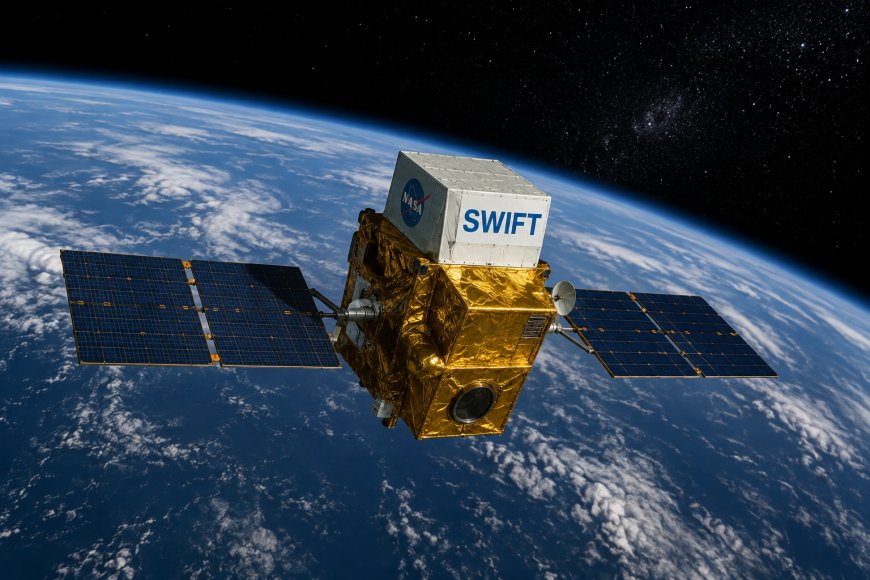
NASA and Katalyst Space have abandoned the central objective of an ambitious mission to rescue the Neil Gehrels Swift Observatory after the robotic spacecraft tasked with raising its orbit developed persistent attitude-control problems.
The LINK spacecraft will no longer attempt to capture Swift or boost it into a higher orbit, NASA confirmed on Aug. 19. Katalyst may still use LINK to approach the observatory and conduct rendezvous and proximity operations, allowing the mission to demonstrate some of the technologies originally planned for the rescue mission.
The decision leaves Swift, a more than 20-year-old space telescope used to study gamma-ray bursts and other energetic events, to continue its gradual descent into Earth’s atmosphere.
NASA had hoped the mission could extend Swift’s scientific life by years while also demonstrating a new commercial satellite-servicing capability.
LINK Was Supposed to Grab Swift and Raise Its Orbit
NASA awarded Katalyst Space a $30 million contract in September 2025 to design, build and launch a robotic servicing spacecraft capable of reaching Swift.
The timetable was unusually aggressive. Katalyst had less than a year to prepare the spacecraft because Swift’s orbit was falling faster than expected. Increased solar activity expanded Earth’s upper atmosphere, increasing drag on satellites operating in low Earth orbit.
The resulting LINK spacecraft launched aboard a Northrop Grumman Pegasus XL rocket on July 3 from Kwajalein Atoll in the Marshall Islands.
The original mission plan called for LINK to rendezvous with Swift, inspect potential attachment points and secure the observatory using three robotic arms. LINK would then use its propulsion system to slowly raise Swift toward an altitude of about 600 kilometres, or roughly 370 miles.
The manoeuvre was expected to take several months.
If successful, it would have extended Swift’s operational life while giving NASA and the U.S. commercial space industry experience with servicing a spacecraft that was never originally designed to be captured in orbit.
Problems Began During LINK’s Commissioning
The rescue plan began to unravel several weeks after launch.
NASA reported on July 28 that LINK had developed an attitude-control problem that caused the spacecraft to spin and resulted in intermittent communications.
A preliminary investigation found that two of LINK’s three reaction wheels were not operating and that the spacecraft had also lost some functionality in its cold-gas thruster system. Reaction wheels are used to control a spacecraft’s orientation without relying entirely on thrusters.
Katalyst engineers spent the following weeks trying to recover control.
By Aug. 6, the team had successfully reduced LINK’s spin. Katalyst then uploaded new flight software with attitude-control algorithms designed to stabilise the spacecraft using the remaining operational actuators.
The recovery effort was enough to keep some mission options open, but it did not restore the spacecraft to the condition required for a safe capture operation.
NASA and Katalyst ultimately concluded that the remaining attitude-control problem made grappling Swift too risky.
LINK Could Still Approach Swift
The mission is not ending completely.
NASA says LINK is still expected to attempt rendezvous and proximity operations with Swift. That means the spacecraft could approach the observatory without physically capturing it.
Those operations could still provide useful data for future satellite-servicing missions.
Autonomous rendezvous, inspection and close-proximity navigation are important technologies for a growing commercial market focused on repairing satellites, extending their operational lives, moving spacecraft between orbits and eventually removing orbital debris.
The loss of the capture-and-boost portion, however, means the mission will not accomplish the task for which it was specifically built.
Why Swift Needed a Rescue Mission
Swift launched on Nov. 20, 2004, and was originally designed to study gamma-ray bursts, extremely energetic explosions that can occur when massive stars collapse, or compact objects such as neutron stars merge.
Its instruments allow astronomers to rapidly observe events in gamma-ray, X-ray, ultraviolet and visible light.
Over more than two decades in orbit, Swift has contributed to research involving exploding stars, black holes, stellar flares, comets and other transient events. It has also become valuable for multimessenger astronomy, in which scientists combine observations of light with signals such as gravitational waves or high-energy particles.
Swift does not have its own propulsion system capable of maintaining its altitude indefinitely.
Like other satellites in low Earth orbit, it experiences a small amount of drag from Earth’s upper atmosphere. That drag gradually lowers its orbit.
The problem accelerated as the Sun entered a period of heightened activity. Increased solar activity warmed and expanded Earth’s atmosphere, increasing the drag acting on Swift.
By January 2025, NASA’s models increasingly indicated that the observatory would reenter Earth’s atmosphere in 2026.
NASA Had Already Changed How Swift Operated
NASA attempted to slow the observatory’s descent while Katalyst prepared the rescue spacecraft.
Beginning in late 2025, Swift’s operations team changed how the telescope was pointed so that the spacecraft presented a more streamlined profile to the atmosphere.
Initially, about one-quarter of the science targets were replaced with pointing directions to reduce drag.
By February 2026, the team had shifted entirely to drag-minimising orientations. That required suspending observations with Swift’s ultraviolet, optical and X-ray telescopes.
The goal was to keep Swift above roughly 300 kilometres (185 miles) in length, long enough for LINK to reach it.
Those operational changes bought additional time, but they were never intended to replace an orbital boost.
Swift Is Still Expected to Reenter
Without the planned boost, Swift is expected to continue losing altitude and eventually enter Earth’s atmosphere.
NASA’s prelaunch mission material said the observatory was on course for reentry in 2026 if its orbit could not be raised.
The precise timing can vary because orbital decay depends in part on atmospheric conditions and solar activity.
When reentry occurs, Swift is expected to burn up as it descends through the atmosphere rather than return intact.
The cancellation therefore puts an approaching end date on one of NASA’s longest-running high-energy astrophysics missions.
The Failure Still Offers Lessons for Satellite Servicing
The Swift Boost Mission was always considered unusually difficult.
Katalyst had to design and build LINK on a compressed schedule, launch it into Swift’s unusual orbit and prepare to physically capture a spacecraft that had spent more than two decades in space and was never designed for robotic servicing.
NASA had described the project before launch as a high-risk effort that could simultaneously save a productive scientific observatory and advance U.S. commercial spacecraft-servicing technology.
The capture will no longer happen, but the remaining proximity operations could still test parts of that technology.
NASA’s decision also shows why satellite servicing remains technically demanding. Reaching another spacecraft is only part of the problem. A servicing vehicle must maintain precise control while operating close enough to inspect, capture, or manipulate another object without damaging either spacecraft.
For Swift, however, those lessons come too late to deliver the orbital boost it needed.
The observatory’s science legacy now appears likely to end with a natural atmospheric reentry later in 2026, while LINK’s remaining mission will focus on demonstrating whatever rendezvous and proximity capabilities its damaged control system can still safely support.
Official Sources :
What's Your Reaction?
 Like
0
Like
0
 Dislike
0
Dislike
0
 Love
0
Love
0
 Funny
0
Funny
0
 Angry
0
Angry
0
 Sad
0
Sad
0
 Wow
0
Wow
0