




































Steam Deck 2 : Could AMD Gainsborough Be the Chip Valve Has Been Waiting For?
Steam Deck 2 review examining AMD Gainsborough, Valve’s performance requirements, current Steam Deck hardware, and what the rumoured chip could mean for a future handheld.
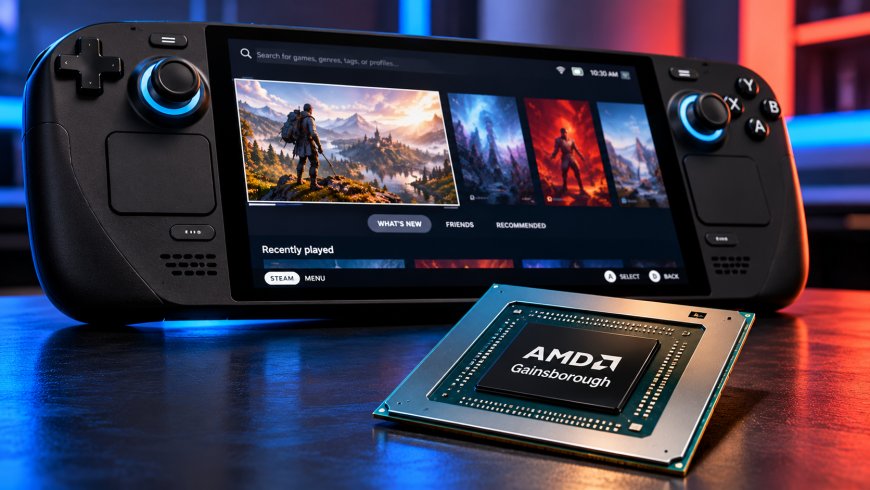
The Steam Deck 2 remains one of the most anticipated upgrades in handheld PC gaming, but Valve has been unusually cautious about replacing its first-generation hardware. The company has repeatedly said a successor needs to deliver a meaningful performance increase without sacrificing the battery life, power efficiency, weight, and affordability that defined the original Steam Deck.
A newly reported AMD chip called Gainsborough has now added another piece to that puzzle. Valve has not confirmed the chip as a Steam Deck 2 component. Still, its reported characteristics and unusual codename have made it a potential candidate for the next-generation handheld.
Why Valve Has Waited for Steam Deck 2
The original Steam Deck uses a custom AMD APU built around Zen 2 CPU cores and RDNA 2 graphics. Valve designed the system around a 4-to-15-watt APU power range, aiming to deliver PC gaming performance in a portable device without turning battery life and thermals into major compromises. Valve’s official Steam Deck hardware information still describes the platform as a power-efficient handheld PC built around a custom AMD APU.
The Steam Deck OLED improved the original design with a more efficient AMD APU, a larger battery, an OLED display, faster wireless connectivity, and updated thermals. It wasn’t intended as a second-generation performance upgrade.
Valve has been clear about what it wants from a true successor. Steam Deck designers have said the company is waiting for a generational performance improvement while maintaining a similar power-and-battery-life balance. Valve’s previous explanation of its Steam Deck 2 strategy shows why the company has rejected the idea of releasing a faster handheld to justify a new model.
What Is AMD Gainsborough?
Gainsborough is an unannounced AMD chip that has surfaced through recent driver and hardware-related reporting. Its name has attracted particular attention because the original Steam Deck APU was known by the codename Aerith. At the same time, Gainsborough is the surname of the Final Fantasy VII character Aerith Gainsborough.
That naming connection is interesting, but it is not proof that Valve is the customer. Reporting around the chip suggests Gainsborough may be a semi-custom AMD design. Still, AMD has not officially announced it as a Steam Deck processor, and Valve has not publicly confirmed it as the Steam Deck 2 processor.
That distinction matters. AMD already develops several processor families for handheld gaming, including its Ryzen Z2 series. Those chips show how much performance AMD can deliver in handheld-focused power envelopes. Still, Valve’s requirements for its successor are more specific than simply using the fastest available handheld APU.
The Power Envelope Is the Important Part
For a device such as the Steam Deck, raw performance is only one part of the equation. A chip that produces higher frame rates but consumes substantially more power could force Valve to use a larger battery, heavier cooling system, or shorter play sessions.
Valve’s current Steam Deck design uses a 40Wh battery and a 4-to-15-watt APU range. That balance is central to the product’s design, which is why the company has emphasised performance gains without sacrificing battery life. Steam’s official Steam Deck specifications provide the current hardware details.
Reports about Gainsborough suggest the chip may have characteristics suited to a low-power handheld design, including a compact package and a potential connection to AMD’s next-generation handheld silicon. However, those details remain part of the current reporting and should not be treated as confirmed Steam Deck 2 specifications.
AMD’s Handheld Chips Have Moved Forward
The broader AMD roadmap shows why Valve has more options than it did when it designed the original Steam Deck. AMD’s Ryzen Z2 family includes Zen 5 and RDNA 3.5 configurations at the high end, alongside lower-power variants. The company lists configurable power ranges starting at 15 watts for several Z2 models. AMD’s official Ryzen Z-series specifications show the range of architectures and power targets now available for handheld PCs.
That progress matters because Valve isn’t simply looking for more CPU cores or a larger graphics configuration. It needs a combination of CPU performance, GPU performance, efficiency, battery consumption, thermals, memory bandwidth, and cost that works inside a handheld chassis.
Could Gainsborough Be the Right Fit?
On paper, Gainsborough is interesting because the reported characteristics appear to overlap with the requirements Valve has described for a Steam Deck successor. A semi-custom design could also give Valve more control over the balance between processing power and efficiency than adopting an off-the-shelf laptop processor would.
But the evidence does not yet establish that Gainsborough is being developed specifically for Valve. Semi-custom silicon can be designed for one customer or application and ultimately appear in a different product. The available information does not reveal the chip’s final commercial destination.
That leaves the most important question unanswered: whether Gainsborough can deliver the substantial performance improvement Valve wants while staying within the power, battery, thermal, and cost limits of a Steam Deck.
What a Steam Deck 2 Would Need
A genuine second-generation Steam Deck would need to improve more than benchmark numbers. Faster CPU and GPU performance would help, but the bigger goal would be running modern PC games at higher settings or more stable frame rates without dramatically increasing power consumption.
Memory bandwidth and graphics efficiency could matter as much as the headline CPU architecture. Modern handheld games increasingly depend on upscaling and other rendering technologies, so a future Steam Deck could also benefit from stronger hardware support for those workloads.
Valve has also demonstrated that it values the ergonomics and software experience of the current device. A new chip therefore has to fit into a broader system rather than simply becoming a faster processor inside the existing hardware.
Pros and Cons of the Gainsborough Possibility
Pros:
- The reported chip appears to fit the type of efficiency-focused hardware Valve has been waiting for
- Its reported semi-custom nature could allow a tighter balance between performance and power consumption
- The timing comes as AMD continues expanding its handheld processor technology
- The Gainsborough name creates a notable connection with the Aerith codename used for the original Steam Deck APU
Cons:
- Valve has not confirmed Gainsborough as a Steam Deck 2 processor
- AMD has not publicly announced the chip as a Steam Deck product
- Reported specifications remain incomplete and unverified
- A new processor alone does not establish a Steam Deck 2 release date or final hardware design
Final Verdict
AMD Gainsborough is an intriguing development because it appears at a time when Valve is actively working toward a next-generation Steam Deck but remains unwilling to launch a modest hardware refresh. The reported chip could fit the efficiency-and-performance balance Valve has described, but the connection is still speculative.
The key point is that Valve’s Steam Deck 2 strategy hasn’t changed: the company wants a substantial performance improvement without sacrificing the characteristics that make the current handheld practical. Until a chip can meet those requirements at an acceptable cost, the Steam Deck OLED remains the latest generation of Valve’s handheld hardware.
Gainsborough may eventually become an important part of the Steam Deck 2 story, but it is too early to treat it as confirmed hardware. For now, the chip is best viewed as a promising lead in the search for the silicon Valve has been waiting for.
What's Your Reaction?
 Like
0
Like
0
 Dislike
0
Dislike
0
 Love
0
Love
0
 Funny
0
Funny
0
 Angry
0
Angry
0
 Sad
0
Sad
0
 Wow
0
Wow
0