



































ChatGPT Computer History Tracks Mac Activity for AI Search
ChatGPT Computer History can track Mac activity, including clicks, typing and app switches, creating a searchable timeline while raising privacy concerns.
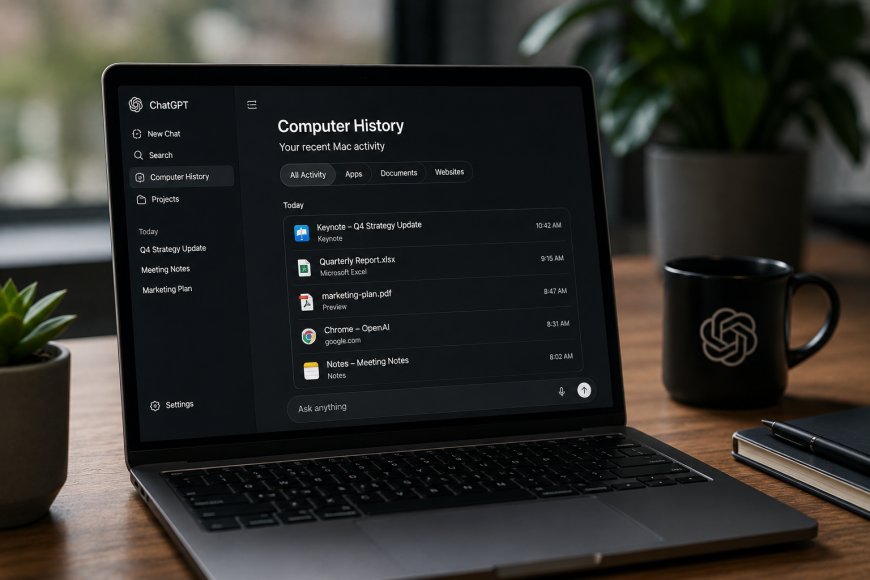
OpenAI is testing a new ChatGPT feature that can keep a searchable record of activity on a Mac, introducing a productivity tool that is already drawing comparisons with Microsoft’s controversial Windows Recall.
Called Computer History, the opt-in feature is designed to help users retrace what they have done on their computer. Instead of relying on a continuous collection of screenshots, the system records interaction events such as mouse clicks, typing, keyboard shortcuts and switches between applications.
That information can then be organised into a timeline that users can search with ChatGPT.
The idea is straightforward: if someone remembers working on a document, visiting a website or performing another task but cannot remember exactly where it happened, Computer History can potentially help locate that earlier activity.
Why Computer History Is Being Compared With Windows Recall
The concept immediately brings Microsoft’s Recall to mind, although the two systems collect activity differently.
Microsoft Recall, currently available in preview on compatible Copilot+ PCs, periodically saves snapshots of what appears on a user’s screen. Microsoft says those snapshots are encrypted and stored locally on the device.
Recall is also opt-in. Users can pause it, delete stored snapshots and exclude supported applications and websites. Microsoft says Windows Hello authentication is required to access saved Recall content.
ChatGPT’s Computer History takes a different approach by concentrating on computer interactions rather than building its history primarily from periodic screenshots.
That distinction could matter for privacy, but the broader question remains similar: how much information should an AI assistant remember about what someone does on a computer?
A Searchable Memory for Your Mac
Computer History could be useful for people who regularly switch between browsers, documents, and applications throughout the working day.
Instead of manually searching browser histories, recent files and individual apps, a user could potentially ask ChatGPT to help reconstruct earlier computer activity.
That moves ChatGPT closer to becoming a persistent desktop assistant rather than an AI tool that only responds to information deliberately entered into a conversation.
The feature is optional, meaning users have to choose to enable it.
Privacy Will Be the Bigger Test
The usefulness of a searchable computer history is easy to understand. The privacy implications are equally important.
Keystrokes and application activity can reveal considerably more than ordinary chatbot conversations. Work documents, searches, private communications and other sensitive activities could potentially become part of a detailed record of how a computer is used.
That makes transparency around storage, retention, exclusions and user controls particularly important as Computer History develops.
Microsoft faced intense scrutiny after first announcing Recall in 2024 and subsequently redesigning parts of the feature to emphasise stronger security and explicit user consent. Recall now requires users to opt in, and Microsoft says saved snapshots remain encrypted on the device and are not shared with Microsoft or third parties.
Computer History is entering a market where users are therefore already familiar with the privacy debate surrounding persistent AI memory.
AI Assistants Are Moving Beyond the Chat Window
Computer History also points toward a broader change in personal AI.
AI assistants increasingly need context to perform more useful tasks. Remembering what someone was working on, which applications they used and where information appeared could make an assistant substantially more capable.
But additional context also means additional data.
The challenge for OpenAI will be demonstrating that Computer History provides enough practical value to justify recording detailed computer activity while giving users clear control over what is collected.
For now, Computer History represents another step toward AI systems that do more than answer questions. They are beginning to remember how people work across their computers, making privacy controls just as important as the intelligence behind the feature.
What's Your Reaction?
 Like
0
Like
0
 Dislike
0
Dislike
0
 Love
0
Love
0
 Funny
0
Funny
0
 Angry
0
Angry
0
 Sad
0
Sad
0
 Wow
0
Wow
0