





















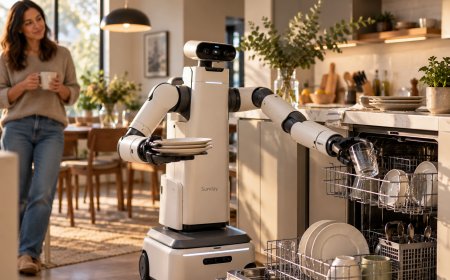










Nvidia’s AVO Harness Pushes Claude Opus 5 to 100% on ARC-AGI-3
Nvidia’s AVO harness pushed Claude Opus 5 from a 30% baseline to a 100% ARC-AGI-3 score, highlighting the role of agent architecture in long AI tasks.

Nvidia researchers have demonstrated how much an AI agent’s surrounding software can influence its performance, using a custom agent architecture to help Claude Opus 5 achieve a perfect score on the public portion of the ARC-AGI-3 reasoning benchmark.
The result came from Nvidia’s Agentic Variation Operators, or AVO, architecture. Using Claude Opus 5, AVO completed all 183 levels across the benchmark’s 25 public environments with a 100.00 Relative Human Action Efficiency score.
The harness can change what a model accomplishes
An AI agent consists of more than its underlying language model. The software surrounding the model, often called a harness, manages elements such as context, tools, memory, feedback and the execution loop that allows an agent to continue working across multiple steps. Nvidia’s AVO system adds persistent memory and a supervising component that monitors the main agent’s progress. The supervisor can intervene when the agent becomes stuck or repeatedly pursues an unproductive approach. At the same time, memory preserves useful information from earlier attempts rather than forcing the system to reconstruct its progress.
Nvidia’s original AVO research focused on autonomous evolutionary search and GPU kernel optimisation. In one experiment, AVO operated for seven days, explored more than 500 optimisation directions and produced kernels that outperformed cuDNN by up to 3.5% and FlashAttention-4 by up to 10.5% across tested configurations on Nvidia B200 GPUs.
Applying the architecture to ARC-AGI-3 tested whether the same long-horizon approach could work outside software optimisation. The benchmark places agents in unfamiliar 2D environments without explicit rules or goals, requiring them to experiment, infer what actions do and preserve what they learn as they progress.
OpenAI found a similar harness effect
Nvidia is not the only organisation finding that benchmark performance can change sharply without changing the underlying model. In July, OpenAI reported that enabling retained reasoning and compaction increased GPT-5.6 Sol’s ARC-AGI-3 public-set score from 13.3% to 38.3% while reducing output token usage.
The comparison reinforces an important limitation of model-only rankings. Nvidia notes that Claude Opus 5 has been reported separately at roughly 30% under a different ARC-AGI-3 setup. Still, it warns that its 100% AVO result should not be treated as a controlled comparison because the systems differ in reasoning settings, memory, context management, observation formats, and other implementation details.
That distinction matters. The research does not prove that the harness is always more important than the model. Still, it shows that evaluating a raw model can provide an incomplete picture of how an autonomous agent will perform once memory, tools and supervisory mechanisms are added.
Long-horizon work remains difficult for AI agents
Other research has highlighted why those system-level controls matter. An April study testing 19 language models on extended document-editing workflows found that even frontier models corrupted an average of about 25% of document content by the end of long delegated tasks. The study also found that larger documents, longer interactions, and distracting files could worsen degradation.
The challenge becomes more consequential when agents can modify files, execute code or interact with external systems. Nvidia has separately argued that security must be enforced across the broader agent stack. In its framework, the harness guides what an agent attempts, while the runtime and infrastructure determine what the agent is actually authorised to do.
Harness choice can also affect cost
Agent architecture can influence both efficiency and accuracy. Databricks has benchmarked various models and coding-agent harnesses on tasks derived from its own large codebase, arguing that companies should measure combinations of models and harnesses rather than assuming that the model alone determines performance or efficiency.
Nvidia’s ARC-AGI-3 result adds another piece of evidence that the model is only one layer of an agentic system. For long-running autonomous work, persistent memory, access to tools, feedback, supervision, and execution controls can determine how effectively a model’s underlying capabilities translate into completed tasks.
What's Your Reaction?
 Like
0
Like
0
 Dislike
0
Dislike
0
 Love
0
Love
0
 Funny
0
Funny
0
 Angry
0
Angry
0
 Sad
0
Sad
0
 Wow
0
Wow
0