



































ARPA-H Commits $117.4 Million to New Biosensor Projects
ARPA-H is committing up to $117.4 million to four biosensor projects targeting heart failure, inflammation and perimenopause.
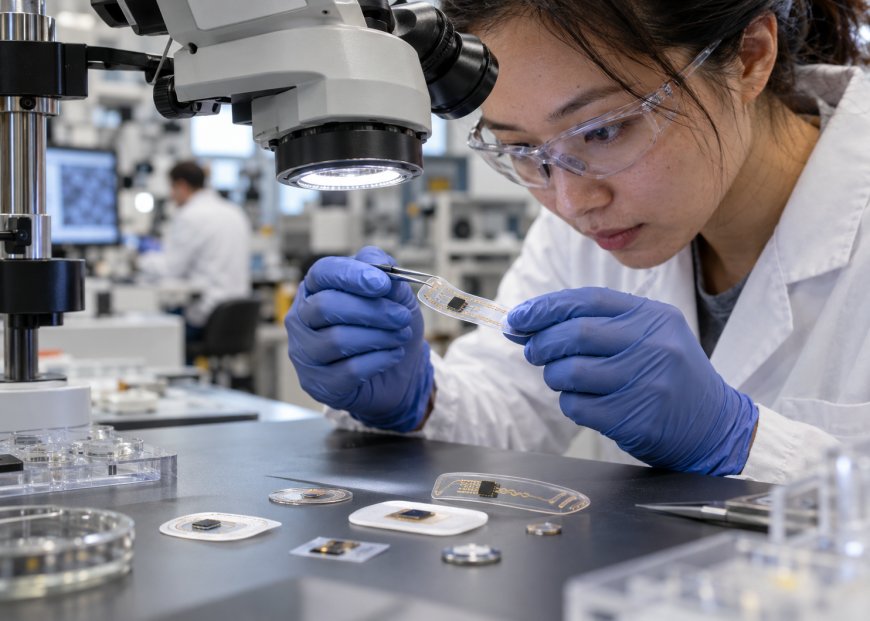
The ARPA-H is investing up to $117.4m in four projects to develop wearable biosensors that will be capable of continuously monitoring biological signals that are very difficult to measure outside of the hospital or lab environment.
The projects are part of ARPA-H's Delphi programme, which uses small modular electronic components (chiplets) as building blocks for its biosensor designs. The aim is to develop chiplets for a range of functions including power management, signal processing, communications, security and biological sensing which can then be combined and re-used in different devices.
ARPA-H has a 4.5-year program in mind with funding linked to research milestones. In the first 18 months, the teams will need to demonstrate that their components work together and meet the security requirements for post-quantum secure communications. By 24 months, they are expected to have a working prototype in living systems and to have identified additional sensors that could allow for the measurement of a wider range of biomarkers.
By month 54, the minimally invasive wearables programmes are due to reach clinical trials and the non-invasive wearables programmes are due to complete their human factors studies. These are programme targets, not evidence that the devices have in fact got to clinical trials.
Four projects are aimed at different health problems.
The largest award is going to the Massachusetts Institute of Technology. Its PYTHIA project will receive up to $37.9 million to develop a wearable patch that continuously senses heart failure biomarkers. The sensor would run on the patient's body heat and use power-efficient processing with AI embedded directly in the device. ARPA-H describes it as a clinical-grade, extensible platform, though it's still in the development stage.
New York University will receive up to $30.8 million for the SENTINEL project, which is focused on continuous inflammation monitoring. Researchers plan to use microscopic probes positioned just beneath the skin along with DNA-based sensors. The wearable will also harvest energy from radio-frequency sources such as Bluetooth and Wi-Fi.
Novelna will receive up to $33.2 million for Novelna's PULSE project, a wearable patch designed to measure inflammation after a heart attack. The project aims to monitor patients after myocardial infarction and reduce hospital readmission. The device will collect data from the human body, maximising battery life. The fourth project (University of Washington) is on the transition through perimenopause. They're developing a wearable sensor that will measure biomarkers directly from sweat via engineered proteins. By changing the local pH of the sensor, they can refresh and reuse those proteins, which will in turn help to maintain the sensitivity and reliability of the sensor over time. This project has an award of up to $7.5m.
Delphi is built on reusable components.
Delphi's architecture is at the heart of the program. ARPA-H notes that many of the existing biosensors are application-specific, making them difficult to repurpose when you want to measure a different biological signal.
The Delphi approach is to split up the key functions into individual chiplets which can be connected together and reused. The agency wants these components to be able to support a range of different wearable and ingestible biosensors rather than having to build a completely new electronic platform for each application. The potential benefit is flexibility. A researcher developing a sensor for one biomarker could in principle change the sensing element and keep the rest of the electronic system.
That's still a development goal. The teams have to show that the architecture works reliably and satisfies ARPA-H's technical requirements before the approach can move on to broader clinical use.
The devices still have to prove themselves.
The $117.4m commitment doesn't mean the four sensors are ready for patients or available as commercial medical devices. They're still in the R&D phase, and each team must meet technical milestones before advancing to the next testing stage. Initial effort will be focused on interoperability, secure communications and the development of prototypes. The later stages will be devoted to testing in living systems and, where appropriate, clinical trials or human factors studies.
That distinction is absolutely critical as the four projects are addressing completely different biological problems. Heart failure, inflammation, recovery following a myocardial infarction and perimenopause all require very different measurements even though they're all being tackled within the same general biosensor framework. The programme is therefore looking at more than just individual sensors. ARPA-H is also looking at whether a common set of electronic building blocks can be used to support a range of medical applications without the need for a completely new platform each time.
Why continuous biosensing matters
Wearable tech has already made continuous monitoring a familiar concept via devices that measure heart rate and blood glucose. Delphi is looking at biological information that's much harder to measure continuously, namely inflammatory markers, hormones and other signals which can give a much more detailed picture of what's going on inside the body.
The four projects illustrate the breadth of ARPA-H's activities. One is on heart failure, one on inflammation, one on recovery following a myocardial infarction and one on the hormonal changes that occur in perimenopause. If the underlying technology works, then ultimately patients and clinicians could have access to more frequent biological data outside of the traditional clinical setting. The projects have not yet shown that.
For now, Delphi is testing whether a reusable biosensor architecture can make it easier to develop new devices for different health conditions. The program has up to $117.4 million and 4.5 years to determine whether that approach can move from research concepts to reliable systems that can eventually be tested in clinical care.
What's Your Reaction?
 Like
0
Like
0
 Dislike
0
Dislike
0
 Love
0
Love
0
 Funny
0
Funny
0
 Angry
0
Angry
0
 Sad
0
Sad
0
 Wow
0
Wow
0