




































Chinese Rocket Company LandSpace Successfully Lands Reusable Zhuque-3 Booster
China’s LandSpace successfully landed the first stage of its Zhuque-3 rocket, marking the country’s first land-based recovery of an orbital-class booster.
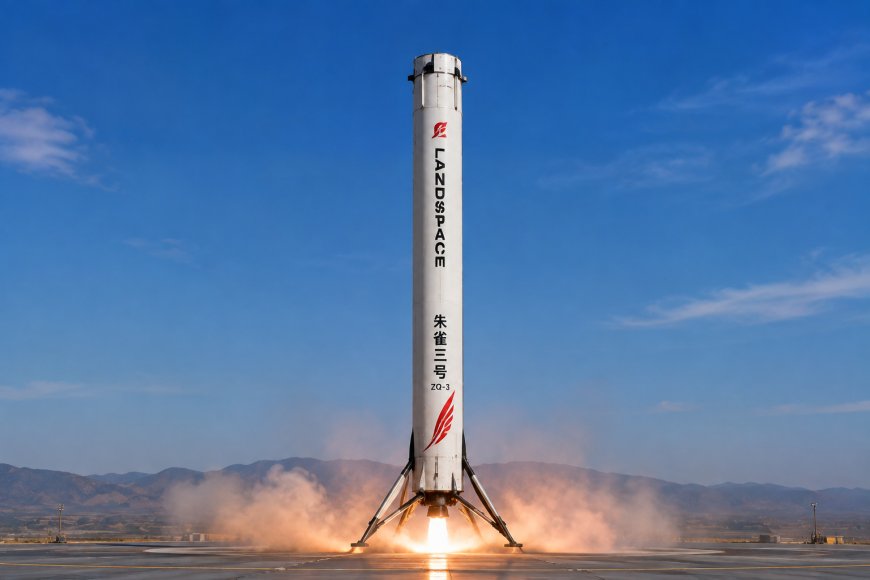
China’s push toward reusable rockets took a major step forward on August 19 when private launch company LandSpace successfully landed the first stage of its Zhuque-3 rocket after an orbital mission.
The Zhuque-3 Y2 lifted off at 7:35 a.m. Beijing time from the Dongfeng Commercial Space Innovation Pilot Zone in northwest China. After stage separation, the upper stage continued toward orbit and deployed the Honghu-03 satellite, while the first stage returned toward Earth.
About six minutes after launch, the booster completed a controlled descent and made a soft vertical landing at LandSpace’s recovery site in Minqin County, Gansu Province.
The flight marked China’s first successful land-based recovery of an orbital-class rocket first stage using deployable landing legs, according to China’s official Xinhua News Agency report on the mission.
For LandSpace, the achievement moves Zhuque-3 closer to the reusable launch model that has transformed the economics of commercial spaceflight in the United States.
Zhuque-3 Reached Orbit and Brought Its Booster Home
The mission had two major objectives: deliver a payload to orbit and prove that the first stage could return safely.
Both were completed.
LandSpace said the first and second stages separated roughly 137 seconds after liftoff. The upper stage continued its flight and successfully placed the Honghu-03 satellite into its planned orbit.
The booster then followed a controlled return trajectory toward the landing site.
Unlike a conventional expendable rocket, which allows its first stage to fall away after launch, Zhuque-3 uses aerodynamic controls, attitude-control systems, restartable engines and landing legs to guide the booster back toward a designated landing zone.
The successful touchdown demonstrates that those systems can work together after an actual orbital launch.
LandSpace has been developing Zhuque-3 specifically around that reusable architecture. The company describes the vehicle as a large liquid-oxygen-and-methane rocket intended for high-frequency launches and large satellite constellation deployments.
LandSpace’s official Zhuque-3 technical information details the rocket’s stainless-steel structure, nine-engine first stage, grid fins, attitude-control equipment and landing legs.
This Was Not China’s First Rocket Recovery
The distinction around the milestone matters.
Zhuque-3 was not the first Chinese orbital rocket booster of any kind to be successfully recovered.
That milestone came just over a month earlier.
On July 10, China’s state-owned space program successfully recovered the first stage of the Long March 10 B after its maiden flight. Instead of landing on solid ground using legs, the Long March booster descended toward an offshore platform and was captured by a net system.
The China Aerospace Science and Technology Corporation described that mission as the country’s first successful controlled recovery of a launch vehicle first stage and the world’s first rocket recovery using a net-based system.
China Aerospace Science and Technology Corporation’s official Long March 10 B recovery report provides details of the July mission.
What makes Zhuque-3 different is how and where it landed.
Its booster returned vertically to solid ground and stood on deployable landing legs, a method more closely resembling the recovery architecture used by SpaceX’s Falcon 9.
It is also a significant milestone for China’s private commercial space industry rather than the country’s state-owned launch program.
LandSpace Had Already Been Testing Vertical Landings
The August 19 success did not come from a single attempt.
LandSpace has spent years developing the technologies required to bring a large rocket stage back to Earth.
In September 2024, the company completed a 10-kilometre vertical takeoff and landing test using its VTVL-1 experimental vehicle.
During that flight, the test vehicle climbed to an altitude of 10,002 meters, shut down its engine, coasted, and then restarted it during descent.
Grid fins, cold-gas attitude control and engine thrust were used together to guide the vehicle toward its landing site.
LandSpace reported that the test vehicle landed only 1.7 meters from the centre of its target area.
LandSpace published the results of that vertical takeoff and landing test on its official website.
Those experiments allowed engineers to test engine restart, aerodynamic control, landing guidance and other technologies before attempting to recover a full orbital-class booster.
Zhuque-3 Uses Methane and Liquid Oxygen
Propulsion is another important part of the Zhuque-3 design.
The rocket uses liquid methane and liquid oxygen rather than the kerosene-and-liquid-oxygen combination used by rockets such as SpaceX’s Falcon 9.
Its first stage uses nine Tianque-series methane engines.
Methane has attracted growing interest among companies developing reusable rockets because it can burn with less residue than kerosene, potentially simplifying inspection and refurbishment between flights.
SpaceX also uses methane and liquid oxygen for Starship, while Blue Origin uses the same broad propellant combination for New Glenn’s BE-4 engines.
LandSpace already has significant experience with methane propulsion.
Its earlier Zhuque-2 became the first methane-fueled rocket to reach orbit in 2023.
Zhuque-3 takes that propulsion technology and combines it with a much larger vehicle designed around first-stage recovery.
The Rocket Is Built From Stainless Steel
Zhuque-3 also uses stainless steel as its primary structural material.
LandSpace says stainless steel offers advantages in manufacturing costs, processing efficiency, temperature resistance, and post-recovery maintenance.
The flight version described by the company is about 66 meters tall with a 4.5-meter-diameter main body and a first stage powered by nine TQ-12A engines.
The vehicle includes grid fins for aerodynamic control and landing legs for the final touchdown.
LandSpace has said its reusable architecture is intended to allow the first stage to fly multiple missions rather than be discarded after each launch.
Its earlier published development targets called for at least 20 uses of a first stage once the system reaches mature operations.
That figure is a design objective, not something Zhuque-3 has demonstrated yet.
A successful landing is only the first part of proving true reusability.
The Next Challenge Is Flying a Recovered Booster Again
Recovering a rocket and reusing a rocket are two different milestones.
The booster that returned on August 19 will now allow LandSpace engineers to examine how its engines, tanks, structure, heat protection, landing hardware, and other systems performed during a complete launch-and-recovery cycle.
That inspection process will determine how much refurbishment is required before a recovered Zhuque-3 stage can safely fly again.
This is where reusable launch systems can produce their largest economic advantage.
Building a new rocket stage for every mission is expensive and time-consuming. If the most costly part of the vehicle can be flown repeatedly with relatively limited inspection and maintenance, the cost of that hardware can be spread across multiple launches.
LandSpace has described its longer-term goal as establishing a cycle of launch, recovery, inspection and reuse.
The August 19 landing proves the recovery portion. Reflight will be the next major test.
China Now Has Two Successful Recovery Approaches
The timing of the Zhuque-3 landing is particularly notable because it came only weeks after the Long March 10 B recovery.
The two vehicles use very different approaches.
The state-developed Long March 10 B returned to an offshore recovery platform and was captured using a net.
LandSpace brought Zhuque-3 back to a conventional landing area using deployable legs.
Both techniques are intended to address the same economic problem: recovering expensive rocket hardware. Back-to-back successes indicate that reusable launch technology is advancing through both China’s government space program and its rapidly expanding private space industry.
Other Chinese companies are developing reusable orbital rockets as well, increasing the likelihood that booster recovery will become a competitive requirement for the country’s commercial launch providers rather than a specialised experiment.
SpaceX Still Has a Major Head Start
LandSpace’s achievement inevitably draws comparisons with SpaceX, but the difference in operational maturity remains enormous.
SpaceX first successfully landed a Falcon 9 booster on land in December 2015. Since then, individual Falcon 9 first stages have flown repeatedly, and booster recovery has become routine rather than experimental.
LandSpace has now demonstrated one of the most difficult technical steps needed to pursue the same general economic model.
It still needs to show that Zhuque-3 boosters can be inspected, refurbished, relaunched and recovered repeatedly without the process becoming too expensive or time-consuming.
That will determine whether the technology actually reduces launch costs.
Reusability Matters for China’s Satellite Plans
The timing is also important because China is planning large low Earth orbit satellite networks that could require thousands of spacecraft launches.
Large constellations create demand for rockets capable of flying frequently and carrying multiple satellites on each mission.
Traditional expendable launch vehicles require manufacturers to build a new first stage for every flight. Reusable vehicles could reduce that production burden and enable higher launch rates.
LandSpace has positioned Zhuque-3 for exactly this type of work.
The vehicle is intended to support satellite constellation deployment, individual spacecraft missions and rideshare launches.
If LandSpace can turn the August 19 landing into repeatable commercial operations, Zhuque-3 could become an important part of China’s expanding private launch market.
For now, the achievement is narrower but still significant. LandSpace has shown that a privately developed Chinese orbital-class booster can launch a payload, return hundreds of kilometres downrange and land upright on its own legs.
The next milestone will be proving that the same hardware can go back to space.
What's Your Reaction?
 Like
0
Like
0
 Dislike
0
Dislike
0
 Love
0
Love
0
 Funny
0
Funny
0
 Angry
0
Angry
0
 Sad
0
Sad
0
 Wow
0
Wow
0