

































Inherent Says Faraday Beats Claude and GPT-5.5 at Replicating Research
Inherent says its Faraday AI agent beat Claude Opus 4.8 and GPT-5.5 on research-replication tasks using a 27B-parameter model and reinforcement learning.
London-based AI startup Inherent says its new scientific agent, Faraday, has outperformed systems built around Anthropic’s Claude Opus 4.8 and OpenAI’s GPT-5.5 on a benchmark designed to test whether AI can independently reproduce published research results.
The result is notable because Faraday is built around Qwen3.6-27B, a comparatively small 27-billion-parameter model. Inherent’s broader goal, however, is not simply to reproduce existing research. The DeepMind alumni-founded lab is working toward AI systems capable of contributing to new scientific discoveries alongside human researchers.
Faraday is trained to replicate scientific research
Inherent developed a training environment called Replica containing 310 tasks derived from 100 machine-learning and AI-for-science papers. Agents are given limited time and computing resources and asked to reproduce figures from published research without access to the original plots.
According to Inherent’s research on Faraday, the agent produced more faithful replications than Claude Opus 4.8 and GPT-5.5 across the company’s evaluation categories, including held-out scientific domains.
The benchmark tests more than whether an agent can reach the correct numerical result. Inherent also evaluates experimental design, scientific rigour, faithfulness to the original research, and resource use, qualities the company describes collectively as “research taste.”
Faraday was trained through long-horizon reinforcement learning, which rewards successful research behaviour rather than relying solely on fixed instructions. Inherent also designed an automated judging system and compared its assessments with those of human researchers to determine whether it captured expert preferences.
A smaller model can direct a larger coding agent
Faraday does not perform every part of the research workflow itself. It uses OpenAI’s GPT-5.5 Codex as a coding tool, allowing the 27-billion-parameter model to direct a substantially larger system while deciding which experiments to pursue and how to interpret their results.
Inherent says this division of labour reflects how it wants AI scientists to operate: not as systems that replace every existing tool, but as research partners capable of deciding what questions and experiments are worth pursuing. The company has also shared the Faraday work publicly as an early demonstration of that approach.
Co-founder and chief scientist Edwar Hughes has emphasised that outperforming frontier agents was not the main objective. The more important question for Inherent is whether reinforcement learning can teach an agent scientific judgment that transfers across different fields and research problems. Hughes has also discussed the research publicly.
Inherent emerged with a $50 million seed round
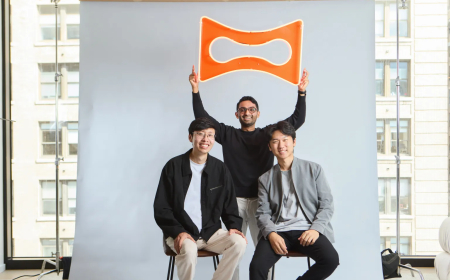
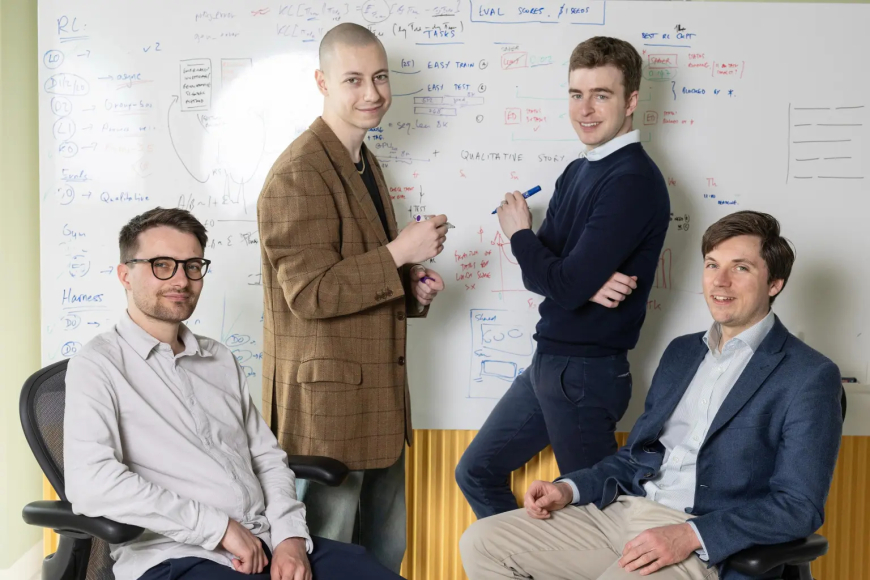
Inherent only recently came out of stealth. The company raised $50 million in a seed round co-led by Index Ventures and Radical Ventures. Its founders include former DeepMind researchers Hughes, Tantum Collins, and Louis Kirsch, as well as Kaloyan Aleksiev, who previously worked at Reka AI and Microsoft.
The startup is part of a broader wave of companies created by former DeepMind researchers. Tech.eu reported that 112 DeepMind alumni had founded or were believed to be preparing to found startups over 18 months, with a significant concentration in the U.K. and the U.S.
Inherent currently operates from London’s King’s Cross AI cluster and plans to increase its roughly dozen-person team to about 20 to 25 employees by the end of the year. Hughes has also criticised the U.K.’s use of lengthy “garden leave” restrictions, which can delay researchers from joining or starting competing companies, an issue that has become part of the broader debate over London’s ability to retain AI talent.
Faraday remains an early research system, and Inherent’s reported benchmark results come from its own evaluation rather than an independent validation. Still, the work provides the first concrete look at how the newly funded lab plans to pursue its larger ambition: AI research partners that can exercise scientific judgment rather than answer questions or generate code.
What's Your Reaction?
 Like
0
Like
0
 Dislike
0
Dislike
0
 Love
0
Love
0
 Funny
0
Funny
0
 Angry
0
Angry
0
 Sad
0
Sad
0
 Wow
0
Wow
0