































Titanfall 2 VR Mod Turns Respawn’s Classic Shooter Into a Full VR Campaign
A free Titanfall 2 VR mod transforms Respawn’s campaign with motion controls, manual reloads, full-body IK and immersive Titan piloting on PC VR.
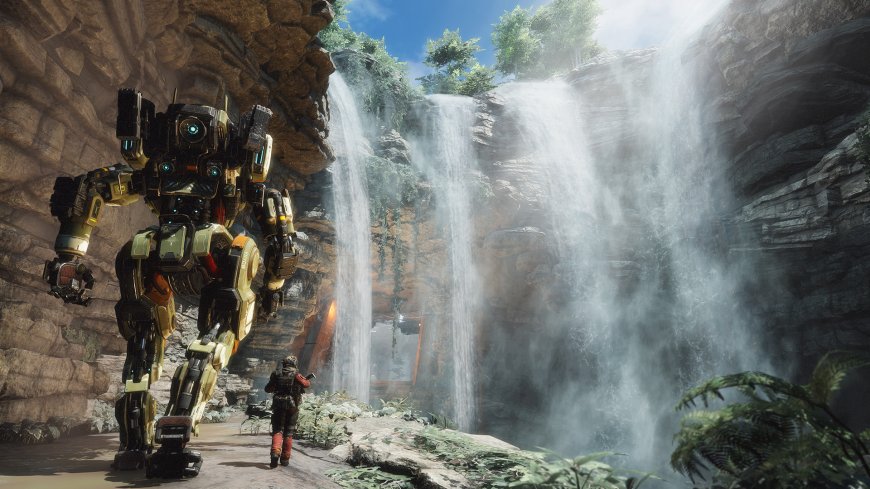
Titanfall 2 was never designed for virtual reality, which is precisely what makes its new community-built VR conversion so interesting. Jordan “CircuitLord” Juarez has transformed Respawn Entertainment’s 2016 shooter into a PC VR experience with stereoscopic rendering, tracked controls, full-body inverse kinematics, manual weapon handling and dedicated Titan interactions.
This is not an official Respawn or Electronic Arts project, and it should not be mistaken for a native commercial VR release. Yet the conversion goes far beyond simply attaching head tracking to an old first-person shooter. Its feature set attempts to reinterpret Titanfall 2’s weapons, movement and mech combat around VR interaction while preserving the original single-player campaign underneath.
Titanfall 2 is unusually ambitious material for a VR conversion
The original Titanfall 2 combines fast first-person gunplay with wall-running, double jumps and battles involving enormous pilotable Titans. Respawn built its single-player campaign around the relationship between Militia rifleman Jack Cooper and the Vanguard-class Titan BT-7274, constantly switching between human-scale movement and mechanised combat.
Those qualities make Titanfall 2 appealing in VR but technically awkward. Traditional VR shooters can design locomotion, weapon handling and environmental interactions around a headset from the beginning. CircuitLord instead has to reinterpret a game whose animations, controls, and camera behaviour were created for a monitor and a conventional controller or mouse.
The resulting mod is therefore better understood as a full conversion than a simple visual patch. The developer’s official VR mod installer lists stereo rendering, full-body IK, manual reloads and Titan controls among its core Titanfall 2 VR features.
Weapons have been rebuilt around physical interaction
Manual reloads are one of the biggest changes. Instead of pressing the original game’s reload button and watching an animation play automatically, the VR conversion breaks weapon handling into actions performed with tracked controllers.
That required more than replacing a button prompt. Titanfall 2 includes a large collection of weapons with different reload sequences, so the modder had to adapt existing animation and audio elements into VR-friendly interactions. Magazines can be handled physically, while weapon components need appropriate interaction points for actions such as operating a slide.
This distinction matters because weapon handling often separates a convincing VR conversion from a conventional game viewed through a headset. Motion-controlled aiming lets the gun move independently from the player’s head. At the same time, manual interactions give the hands a practical purpose rather than simply recreating gamepad inputs in three-dimensional space.
Full-body IK makes Titanfall’s movement more believable
The project also includes full-body inverse kinematics, or IK, which allows the virtual body to respond to tracked movement rather than leaving the player as a floating camera with disconnected hands.
That is especially relevant in Titanfall 2 because movement is central to the game’s identity. Pilots sprint through environments, jump between surfaces and run along walls at speeds that would be unusual even for many purpose-built VR games.
Seeing a virtual body react to those movements can help preserve spatial context as the original game’s camera becomes a headset-controlled viewpoint. It does not change how extreme Titanfall’s movement system is, however. Players sensitive to artificial locomotion should approach an experience built around rapid acceleration, jumping, and wall-running cautiously.
Titan combat may be the conversion’s most natural fit
Titanfall 2 alternates between agile Pilot gameplay and sections inside giant Titans. In VR, those mech sequences have an obvious advantage: the cockpit already provides a believable physical frame around the player.
The conversion includes dedicated Titan controls and allows the player to look around from inside the machine rather than treating the cockpit as a fixed flat-screen viewpoint. Motion input also helps translate the scale of controlling a machine much larger than the Pilot outside it.
That contrast could be one of the project’s strongest design ideas. Pilot sections are intentionally fast and exposed, while entering a Titan places the player inside a large enclosed cockpit. The change in scale already mattered in Respawn’s original design, and VR could make that transition much more tangible.
The entire campaign is the focus, not just a VR demonstration
The project centres on Titanfall 2’s single-player campaign rather than a short collection of demo levels. EA describes the original campaign as a story built around Cooper and BT-7274 after the pair become stranded behind enemy lines following a failed Militia operation.
Preserving that campaign matters because much of Titanfall 2’s reputation comes from how often its levels introduce new mechanics and environments. A VR conversion therefore has more material to work with than a repetitive combat sandbox.
At the same time, not every element translates perfectly. Some sequences created for traditional presentation still reveal the compromises involved in converting an existing game rather than developing one specifically for VR. Cutscenes and scripted camera moments are particularly difficult because moving the player’s viewpoint without corresponding physical motion can be uncomfortable or visually awkward.
The project should therefore be viewed as an evolving community conversion rather than a finished commercial remaster. The developer continues to update it, and some behaviours may change as they address additional issues.
Installation is unusually streamlined for a community VR mod
Complex installation procedures can make ambitious PC mods inaccessible to people who are not accustomed to manually copying files or resolving dependencies. CircuitLord has tried to reduce that friction with a dedicated installer.
The installer detects supported Titanfall 2 installations, checks the required EA app environment and installs the necessary components into a separate TF2VR profile. It also installs Northstar, the community Titanfall 2 modding framework used for the conversion.
Northstar itself is a well-established community framework that enables custom Titanfall 2 content and scripting. In this case, the VR installer handles much of the setup automatically instead of asking the player to configure the framework manually.
Another practical advantage is that launching Titanfall 2 normally remains separate from the VR installation. The installer also keeps VR campaign saves in their own location, reducing the risk of the conversion interfering with a player's standard campaign progress.
This remains an unofficial PC project
The mod’s accessibility should not obscure its unofficial status. CircuitLord explicitly states that the project and installer are community creations and are not affiliated with or endorsed by Titanfall 2’s developers or publisher.
That means users should expect a different support model from a commercial VR release. Compatibility problems, game updates, headset differences, and changes to supporting software can create issues that a professional development and QA organisation would normally handle.
The current focus is also the campaign. Players interested primarily in Titanfall 2’s multiplayer should not assume the VR conversion provides the same scope of online functionality. The developer has discussed multiplayer work, but it is not part of the core campaign feature set documented by the current installer.
It also shows why older PC games are attractive VR targets
Titanfall 2 demonstrates an interesting route for VR development. Building a large campaign from scratch requires years of environment production, level design, animation, writing and testing. Converting an existing PC game begins with those expensive assets and systems already in place.
That does not make VR conversion easy. Camera behaviour, aiming, interactions, interface elements, cutscenes and animation systems can all require substantial reworking. But community projects can focus on adapting interactions rather than rebuilding an entire game’s content pipeline.
Titanfall 2 is particularly well suited to that approach because the underlying game remains technically accessible on modern PCs. EA’s published PC requirements date back to the game’s 2016 release, but VR adds rendering demands not covered by those original specifications.
Pros and Cons
Pros:
- Converts Titanfall 2’s full single-player campaign rather than offering only a short VR demonstration.
- Includes stereo rendering, full-body IK, manual reloads and motion-controlled interactions.
- Dedicated Titan controls make the game’s cockpit combat particularly well suited to VR.
- A dedicated installer handles the Northstar setup and keeps the VR configuration separate from the standard game.
- VR campaign saves are stored separately from normal Titanfall 2 progress.
Cons:
- The conversion is an unofficial community project without EA or Respawn support.
- Titanfall 2’s extremely fast movement may be challenging for players sensitive to artificial VR locomotion.
- Some traditionally presented sequences and cutscenes do not translate as naturally as native VR content.
- The current project is primarily focused on the single-player campaign rather than providing a complete VR replacement for every Titanfall 2 mode.
- Hardware compatibility and performance can vary more than they would with a commercially supported VR release.
Final Verdict
Titanfall 2 VR stands out because its developer has not treated virtual reality as a new camera mode. Manual weapon interactions, tracked aiming, full-body IK and dedicated Titan controls show an effort to translate the original game’s mechanics into something that behaves more like a native VR experience.
There are unavoidable compromises. Titanfall 2 was built around extraordinary speed, scripted presentation and conventional controls, and an unofficial conversion cannot erase every sign of those origins. Players also need to accept the additional troubleshooting and variability that come with community-developed VR software.
For PC VR owners who already appreciate Respawn’s campaign, however, the project offers a compelling reason to revisit it from an entirely different perspective. More importantly, Titanfall 2 VR demonstrates how community conversions can give established games a second life without waiting for publishers to finance full commercial VR remakes. It is still evolving, but its combination of an acclaimed campaign and unusually deep VR interaction makes it far more ambitious than a novelty mod.
What's Your Reaction?
 Like
0
Like
0
 Dislike
0
Dislike
0
 Love
0
Love
0
 Funny
0
Funny
0
 Angry
0
Angry
0
 Sad
0
Sad
0
 Wow
0
Wow
0