



































Binance Launches Agent OS for AI-Powered Crypto Trading
Binance launches Agent OS, allowing AI agents to analyse markets and trade crypto with user-controlled permissions, sub-accounts, and preset safeguards.
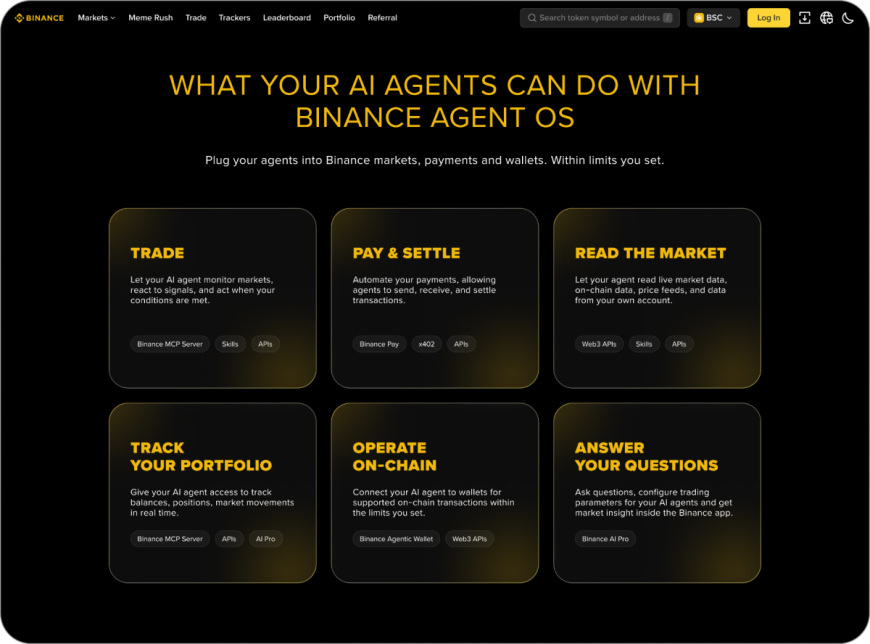
Binance is opening more of its trading infrastructure to autonomous AI agents, allowing software agents to analyze markets, access account information and execute trades on behalf of users. The new platform, called Agent OS, moves AI on the exchange beyond answering questions and toward taking financial actions with real money.
Binance, which says it has more than 300 million registered users, is positioning Agent OS as a developer platform that connects AI applications to its existing trading, wallet and payment infrastructure. The system brings together Binance APIs, its Wallet Agentic Hub, x402 transaction verification, payment tools and Binance Skill Hub.
Agent OS also introduces support for the Model Context Protocol, or MCP, which provides a standardised way for AI applications to interact with external tools and data. Binance has published MCP server documentation for developers building agent-based applications.
AI agents can analyse markets and place trades.
The platform can work with AI development tools including OpenAI’s ChatGPT and Codex, Anthropic’s Claude Code and Cursor. Once authorised, an agent can access market information, review account data and perform actions allowed by the user’s permissions.
Trading is one of the first major uses Binance is targeting. Agents can monitor markets, conduct research, analyse risk, react to signals and execute strategies such as arbitrage. Depending on how an account is configured, an agent can either request approval before placing each order or operate autonomously after receiving permission.
The greater autonomy also creates a significant risk-management question: who decides how much control an AI system should receive? Binance is largely placing that responsibility on the account holder.
Jeff Li,Binance’ss vice president of product, said the company is avoiding unrestricted agent access and instead giving users granular control over what agents are allowed to do. Those controls are applied at the account level.
Sub-accounts act as the main trading safeguard.
Binance’s primary defense is the use of dedicated sub-accounts. A user can assign an AI agent to a separate account and give it access only to specific activities, such as spot or futures trading. Withdrawals from those sub-accounts are blocked by default, helping separate an agent’s activity from the user’s primary account.
Binance does not impose an additional platform-wide cap on how much an agent can trade or lose inside an authorised trading sub-account. Instead, the balance transferred into that account effectively becomes the user’s financial exposure limit.
That makes account configuration particularly important. A user who funds an agent-controlled sub-account with a limited amount can restrict the potential loss, while giving an agent access to a larger balance creates correspondingly greater exposure.
Existing Binance security, risk-control and anti-money-laundering rules for sub-account APIs also apply to Agent OS at launch.
Binance cannot see why an outside AI agent made a trade
Another limitation involves the reasoning behind an agent’s decisions. Li said the AI’s decision-making happens outside Binance’s systems, either locally on a user’s computer or within the AI application the user has selected.
As a result, Binance can observe the trading activity that reaches its platform but cannot necessarily see what information or reasoning caused the agent to make a specific decision.
That distinction matters if an AI system acts on inaccurate information, behaves unexpectedly or is manipulated through techniques such as prompt injection. Binance can control what an agent is authorised to access, but the exchange may have limited visibility into how an external AI model reached the decision that produced a transaction.
Li pointed again to restricted sub-accounts as the main safeguard in those situations. The model is designed to contain potential damage by limiting the assets and permissions available to the agent rather than giving Binance direct oversight of the AI’s reasoning process.
Agent OS extends beyond exchange trading
Binance is also connecting AI agents to payments and blockchain activity. Through its x402 integration, agents can make and settle payments, while its Agentic Wallet can interact with tokens and decentralized-finance protocols.
Unlike trading sub-accounts, some Agentic Wallet activities have Binance-set daily transaction limits. Regular swaps are capped at $50,000 per day, DeFi transactions have a default daily limit of $100,000, and x402 payments are limited to $20 per day, according to the company.
Those limits create a more controlled environment for autonomous wallet activity, while exchange trading continues to depend more heavily on the permissions and funding limits chosen by individual users.
Crypto exchanges are racing to support AI agents
Binance is not alone in connecting AI agents directly to financial infrastructure. Rival exchanges are also using MCP and related developer tools to allow AI applications to move from market analysis into account actions and trading.
Kraken introduced an open-source command-line interface with an MCP server that can give AI agents access to functions including spot and futures trading.
Coinbase followed with Coinbase for Agents, which connects AI agents to user accounts for trading, payments and other financial workflows within permissions established by the account holder.
OKX has taken a similar approach with its Agent Trade Kitprovidingng developerwith s toolto connectng AI agents tcrypto marketet functions.
For Binance, Agent OS is an early step toward a broader platform where developers can build AI applications that operate across financial markets. The technology can make trading and financial workflows more autonomous, but its launch also makes the limits placed on those agents increasingly important. For now, much of that responsibility remains with the user, who decides,who decides how much money, access, and independence an AI agent should receive.
What's Your Reaction?
 Like
0
Like
0
 Dislike
0
Dislike
0
 Love
0
Love
0
 Funny
0
Funny
0
 Angry
0
Angry
0
 Sad
0
Sad
0
 Wow
0
Wow
0