




































Honor Robot Phone Turns a Flagship Into a Moving AI Camera
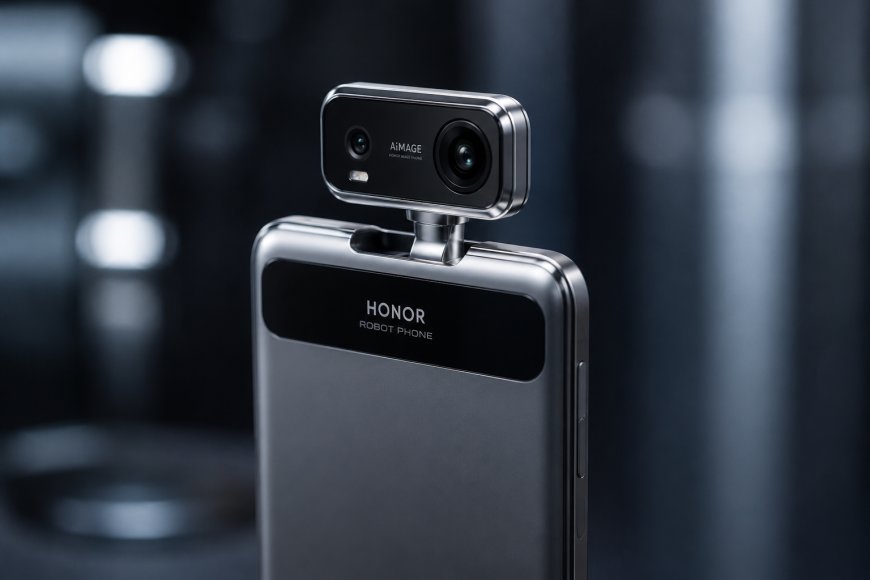
Honor has officially launched one of the most unusual smartphones of 2026, turning a conventional flagship into something closer to a pocket-sized robotic camera.
The Honor Robot Phone uses a motorized gimbal-mounted camera that physically moves out of the device, tracks subjects and responds to users with motion. Honor describes it as a “new species of smartphone,” combining embodied AI, cinematic imaging and robot-like interaction.
It is no longer just a concept.
Honor launched the Robot Phone in China on Aug. 12, with sales beginning Aug. 18. The phone starts at RMB 9,999 for the 12GB RAM and 512GB storage model, while the 16GB and 1TB version costs RMB 12,999.
A Camera That Physically Moves
The standout feature is the phone’s motorized camera system.
Honor calls it the Titanium Agile Gimbal, a compact four-degrees-of-freedom robotic arm built directly into the phone. The mechanism can extend from the device and move the camera independently rather than relying only on digital stabilization.
The main camera uses a 200-megapixel sensor and can rotate through roughly 300 degrees. The system supports AI-powered subject tracking, allowing the camera to follow a person or object while recording.
That makes the Robot Phone feel closer to a DJI-style pocket gimbal camera than a traditional smartphone.
The difference is that the gimbal is built directly into the phone.
Honor Wants the Camera to Behave Like a Robot
The moving camera is not only designed for photography.
Honor also uses it as part of the phone’s AI interface.
Through YOYO Robot Mode, the camera module can move during interactions, including nodding, shaking and reacting to gestures. Honor says the movement is intended to give the device a form of body language rather than limiting AI interaction to text and voice.
It can even move to music and perform small robotic gestures.
That is where the “Robot Phone” name begins to make more sense.
The device does not walk around like a humanoid robot, but its camera system gives the phone a moving physical component that can react to its environment.
ARRI Brings Cinema Technology to the Phone
Honor has also partnered with professional cinema-camera company ARRI.
The collaboration brings ARRI image science and professional-style color tools to the Robot Phone, including support for ARRI Log C3 and ARRI Wide Gamut 3 workflows.
Honor also developed a dedicated imaging processor called the Honor Imaging Chip H1 to handle demanding video-processing tasks alongside the Snapdragon platform.
The company says the additional hardware is intended to improve real-time tone mapping, exposure, white balance and cinematic video processing.
For creators, that could make the Robot Phone more interesting than a typical flagship camera upgrade.
Instead of simply adding another sensor or increasing megapixel counts, Honor has changed how the camera physically operates.
Flagship Hardware Underneath
The rest of the phone is also firmly positioned in premium territory.
The Robot Phone is powered by Qualcomm’s Snapdragon 8 Elite Gen 5 platform and is available with up to 16GB of RAM and 1TB of storage.
It uses a 6.31-inch display and includes a large 7,060mAh battery, unusually substantial for a device that also contains a mechanical camera system.
The phone weighs around 248 grams, making it heavier than many conventional flagships but still relatively compact considering the hardware built into it.
Durability Is the Obvious Question
The moving camera also introduces a major compromise.
Traditional smartphones have spent years removing mechanical components because moving parts can create durability problems.
The Robot Phone goes in the opposite direction.
Its retractable gimbal adds motors, hinges and mechanical components that could potentially be vulnerable to drops, dust or water.
The device carries an IP54 rating with the gimbal closed, meaning its environmental protection is more limited than the IP68 or IP69 ratings now found on some high-end smartphones.
That does not make the design impractical, but it does create an obvious trade-off between innovation and durability.
A Phone Built for Creators
The Robot Phone makes the most sense for people who shoot a lot of video.
A motorized camera that automatically follows a subject could be particularly useful for vloggers, solo creators and people filming themselves without another person behind the camera.
Subject tracking can keep someone centered while they move, while the gimbal provides physical stabilization that conventional electronic stabilization cannot fully reproduce.
The camera can also rotate for selfies and unusual shooting angles without requiring a separate front-facing system.
That versatility is where the design becomes more than a novelty.
The Price Makes It a Niche Device
At RMB 9,999 for the base model, the Robot Phone is clearly not aimed at mainstream buyers.
That price translates to roughly the same territory as premium flagship and foldable phones, although international pricing would vary if Honor eventually launches the device outside China.
For most people, a conventional flagship will remain simpler, lighter and more durable.
But the Robot Phone is not really trying to be conventional.
Honor is using it to explore what happens when smartphone AI gains a physical component instead of existing only behind a screen.
The Smartphone Camera Just Became Mechanical Again
Smartphone design has become increasingly predictable.
Most premium phones now use similar glass-and-metal bodies, large camera modules and rectangular displays. Improvements typically come from better processors, larger sensors or increasingly sophisticated AI software.
The Honor Robot Phone breaks that pattern.
Its camera physically moves. It tracks people. It reacts to users. It combines smartphone computing with a miniature robotic gimbal and professional imaging tools.
There are legitimate questions about durability, price and whether most consumers actually need a moving camera in their phone.
But it is difficult to call the Robot Phone boring.
Honor has taken one of the most mature product categories in consumer technology and introduced something genuinely unusual.
For an industry often criticised for making smartphones look increasingly similar, that alone makes the Robot Phone one of the most interesting devices of 2026.
What's Your Reaction?
 Like
0
Like
0
 Dislike
0
Dislike
0
 Love
0
Love
0
 Funny
0
Funny
0
 Angry
0
Angry
0
 Sad
0
Sad
0
 Wow
0
Wow
0