



































Illinois Age-Verification Law Pushes Checks Into Operating Systems
Illinois’ new age-verification law brings age assurance to devices, operating systems, and apps, raising new privacy and compliance questions online.
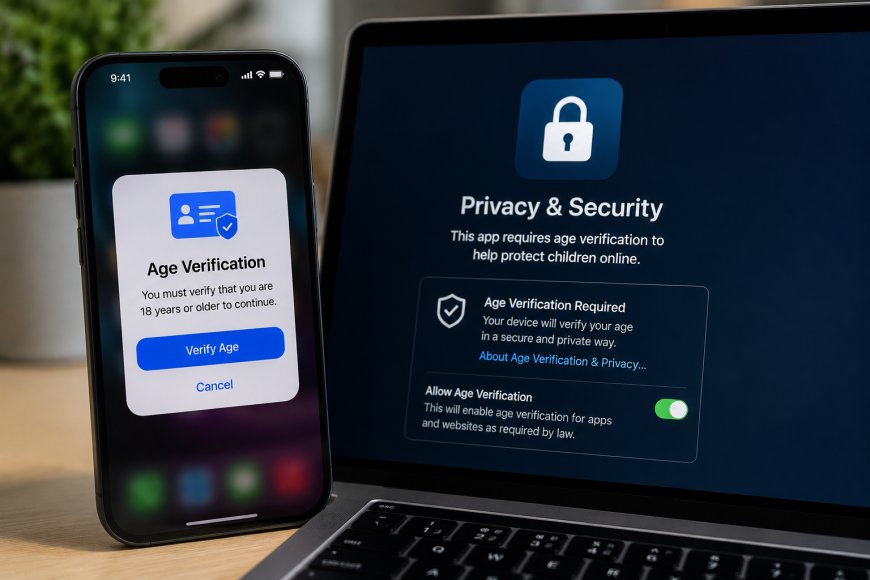
Illinois is taking online age verification deeper into the technology stack with a new law that places responsibilities not only on social media companies but also on device makers, operating system providers, and app stores.
Gov. JB Pritzker has signed HB5511, the Children’s Online Social Media Safety Act, establishing a framework that would allow online services to provide age-related information without requiring each app to perform its own identity check.
The approach represents a significant shift in the growing U.S. debate over how children should be identified and protected online.
Instead of leaving age verification entirely to websites and social networks, Illinois is pushing part of that responsibility toward the devices and software platforms people use to access them.
Operating Systems Are Now Part of the Age-Verification Debate
Under the Illinois framework, companies covered by the law can include device manufacturers, operating-system providers and app-store operators.
That distinction matters because age-assurance requirements have traditionally focused more heavily on individual websites and online services.
Moving verification closer to the operating-system or device level could allow age information to be established once and then communicated to services that need it.
Supporters of this model argue that it can reduce the need for individual apps to repeatedly ask users for identification, facial scans or other sensitive information.
But it also raises a different privacy question: should an operating system know a user’s age and provide age-related signals to software running on the device?
Age Verification Is Moving Down the Tech Stack
Illinois is not acting in isolation.
Age-assurance laws and proposals have been spreading across the United States, with states experimenting with different approaches involving websites, app stores and operating systems.
The broader trend is increasingly pushing responsibility away from individual websites and toward the infrastructure through which users access online services.
That could have consequences for major technology platforms as well as smaller and open-source operating systems.
Implementing age-assurance requirements is relatively straightforward for companies that control accounts, hardware, and app distribution systems. It can be more complicated for decentralised software projects that do not rely on conventional user-account infrastructure.
The issue has already drawn concern from developers and digital rights advocates as similar legislation advances in other states.
The Privacy Trade-Off
Age verification presents regulators with a difficult balance to strike.
Governments want stronger safeguards preventing children from accessing inappropriate services or features. At the same time, proving a person’s age can require collecting information that users may not otherwise need to provide.
Government-issued identification, facial age estimation, and other verification methods can pose privacy and data security risks if implemented poorly.
A device-level approach attempts to reduce repeated verification by allowing a trusted platform to provide an age signal instead.
That could mean an app learns that a user belongs to a particular age group without receiving the underlying identity document used to establish it.
Whether that results in better privacy will depend heavily on how systems are implemented, what information is collected, how long it is retained and which companies can access it.
This Could Affect More Than Windows, Android and iOS.
Large platforms such as Microsoft Windows, Google’s Android and Apple’s operating systems naturally receive much of the attention when operating-system regulation is discussed.
But laws written broadly around operating-system providers can create questions for Linux distributions and other open-source software.
Unlike Apple, Google or Microsoft, many open-source operating systems do not have a single company controlling every installation or a centralised account for every user.
That creates practical questions about who would be responsible for implementing age-assurance features and how compliance would work for freely distributed software.
Similar concerns have emerged around age-verification legislation elsewhere in the United States, making open-source software an increasingly important part of the policy debate.
A Bigger Shift in Internet Regulation
Illinois’ approach highlights how quickly online child-safety regulation is evolving.
The debate is no longer limited to whether social-media companies should verify users’ ages. Lawmakers are increasingly asking whether age information should be established at the device, operating system, or app store level before a user even reaches an individual online service.
That could reduce repeated verification requests, but it could also make age-assurance infrastructure a standard part of everyday computing.
For technology companies, the challenge will be complying with a growing patchwork of state requirements while maintaining privacy, security and compatibility.
For users, the more fundamental question is whether shifting age verification into the operating system creates a safer way to protect children online or moves sensitive identity decisions deeper into the devices people use every day.
Either way, age verification is moving beyond websites. It is becoming an operating-system issue.
Official Government Source:
Illinois General Assembly — HB5511 / Public Act 104-0664
What's Your Reaction?
 Like
0
Like
0
 Dislike
0
Dislike
0
 Love
0
Love
0
 Funny
0
Funny
0
 Angry
0
Angry
0
 Sad
0
Sad
0
 Wow
0
Wow
0