
































Framework Laptop 13 Pro Makes the Modular Laptop Feel Real
Framework Laptop 13 Pro brings modular ports, upgradeable memory, Intel Core Ultra power, a 74Wh battery and a premium, repairable aluminium design.
Framework has spent years arguing that laptops should be repairable, upgradeable, and customizable rather than becoming disposable electronics once a component fails or a processor becomes outdated.
With the Framework Laptop 13 Pro, that idea feels more mature than ever.
The new model is a major redesign of the company’s 13-inch notebook, combining Framework’s familiar modular philosophy with a more premium aluminium chassis, a larger battery, a new touchscreen and Intel’s latest Core Ultra Series 3 processors.
Framework introduced the Laptop 13 Pro in April 2026, with the DIY Edition originally starting at $1,199 and pre-built configurations at $1,499.
A More Premium Framework Laptop
Earlier Framework laptops were easy to repair and upgrade, but they were not always competitive with premium notebooks in areas such as build quality, battery life and trackpad feel.
The Laptop 13 Pro is designed to close that gap.
The Framework uses a fully CNC-machined aluminium chassis, giving the laptop a more rigid and refined construction than earlier models. The keyboard deck now includes a haptic touchpad, while the display has also been redesigned.
The 13.5-inch touchscreen offers a 2880 x 1920 resolution and supports a variable refresh rate ranging from 30Hz to 120Hz. The Framework lists a peak brightness of up to 700 nits.
Those upgrades move the Laptop 13 Pro closer to the premium Windows and MacBook category rather than leaving modularity as its only major selling point.
Intel Core Ultra Series 3 Powers the New Design
The Laptop 13 Pro uses Intel Core Ultra Series 3 processors, including configurations built around the Core Ultra X7 358H.
The Framework’s higher-end test configuration pairs the processor with Intel Arc B390 integrated graphics, 32GB of memory, and 1TB of storage.
The new chips are important not only for performance but also for efficiency.
Framework claims up to 20 hours of battery life in its own testing, aided by a significantly larger 74Wh battery and a display designed specifically for power efficiency.
Independent reviews have also found battery life to be significantly better than previous Framework Laptop 13 generations, although real-world results vary by workload and configuration.
LPCAMM2 Keeps Memory Upgradeable
One of the more important changes is Framework’s move to LPCAMM2 memory.
Many thin laptops use soldered LPDDR memory, which saves space and power but cannot be upgraded after purchase.
LPCAMM2 offers a different approach.
The memory remains removable and replaceable while providing many of the efficiency benefits associated with modern low-power memory. That allows owners to upgrade RAM without replacing the entire mainboard.
Framework supports up to 64GB of LPCAMM2 memory on the Laptop 13 Pro.
For developers, creators and users who keep laptops for several years, that could be one of the system’s biggest advantages.
The Ports Are Still Modular
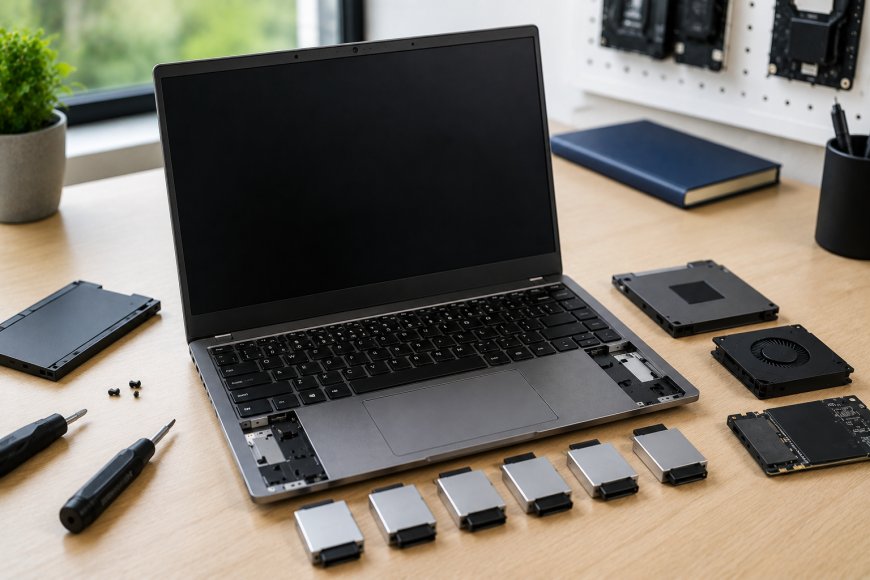
Framework’s Expansion Card system remains one of the most recognizable parts of the laptop.
Instead of permanently choosing a fixed combination of USB-A, USB-C, HDMI, DisplayPort, or storage ports, users can swap small Expansion Cards as needed.
That means someone can configure the laptop differently for travel, desk use or presentations without relying entirely on external dongles.
It also reduces one of the frustrations of thin laptops: being locked into whatever ports the manufacturer decided to include when the device was built.
Older Framework Parts Still Matter
Perhaps the most important part of Framework’s strategy is backward compatibility.
The company continues to sell replacement mainboards, displays, keyboards, batteries and other components separately.
Many parts from the Laptop 13 ecosystem can also be upgraded independently rather than forcing owners to buy an entirely new machine.
That makes the Laptop 13 Pro fundamentally different from most premium laptops.
A processor upgrade, for example, can potentially be achieved by replacing the mainboard while retaining the display, chassis, SSD and other components.
Framework has spent years building its Marketplace around that concept, and the Laptop 13 Pro continues it rather than abandoning modularity for a more premium design.
Linux Support Is a Major Part of the Pitch
Framework is also targeting developers and Linux users more directly.
The Laptop 13 Pro is Framework’s first system to ship with Ubuntu pre-installed, and the company has emphasized Linux support as one of the machine’s core strengths.
That makes the machine particularly interesting for developers who want premium hardware without being tied to Windows or macOS.
Framework has even positioned the Laptop 13 Pro as the type of high-end Linux notebook that has traditionally been difficult to find.
The Biggest Problem Is Price
The modular concept works.
The harder question is whether buyers can afford it.
Memory and storage costs have risen sharply in 2026, and Framework has already adjusted the pricing of the Laptop 13 Pro as component costs have changed.
Some high-end configurations became hundreds of dollars more expensive than their original pricing, particularly those using large LPCAMM2 memory modules. Independent reviews have highlighted the price increases as one of the Laptop 13 Pro’s biggest weaknesses.
That creates an uncomfortable trade-off.
The Framework’s philosophy can save money over the long term because individual components can be repaired or upgraded.
But the upfront cost can be considerably higher than similarly equipped conventional laptops.
Repairability Is Still the Real Feature
The Laptop 13 Pro is not the fastest laptop in every benchmark, nor is it the cheapest.
Its real advantage is ownership.
If the battery wears out, it can be replaced. If the keyboard fails, it can be replaced. If a faster processor arrives later, the mainboard can potentially be upgraded. Ports can be changed. Memory and storage remain accessible.
Most modern laptops are designed around the opposite philosophy.
Components are increasingly soldered, glued or integrated so tightly that a single failure can repair difficult or uneconomical.
Framework is betting that buyers will value keeping a laptop for longer more than having the thinnest possible machine.
The Modular Laptop Is No Longer Just an Experiment
The original Framework Laptop proved that a repairable notebook could work.
The Laptop 13 Pro aims to prove that the same concept can compete with premium machines without sacrificing what makes Framework different.
It is thinner, more refined, more efficient, and more powerful than earlier generations, while keeping the modular ports, replaceable mainboard, upgradeable memory, and repairable construction that define the brand.
The high price remains a serious limitation, especially in a year when memory and storage costs are volatile.
But the broader achievement is difficult to ignore.
Framework no longer needs to prove that a modular laptop can exist.
The Laptop 13 Pro shows that a modular laptop can also feel like a genuinely premium computer.
What's Your Reaction?
 Like
0
Like
0
 Dislike
0
Dislike
0
 Love
0
Love
0
 Funny
0
Funny
0
 Angry
0
Angry
0
 Sad
0
Sad
0
 Wow
0
Wow
0