





































Discovered Materials Raises $9M to Use AI to Develop Cooler, More Efficient Chips
Discovered Materials has raised $9 million to use AI agents and physics models to discover semiconductor materials that could reduce heat and improve chip efficiency.
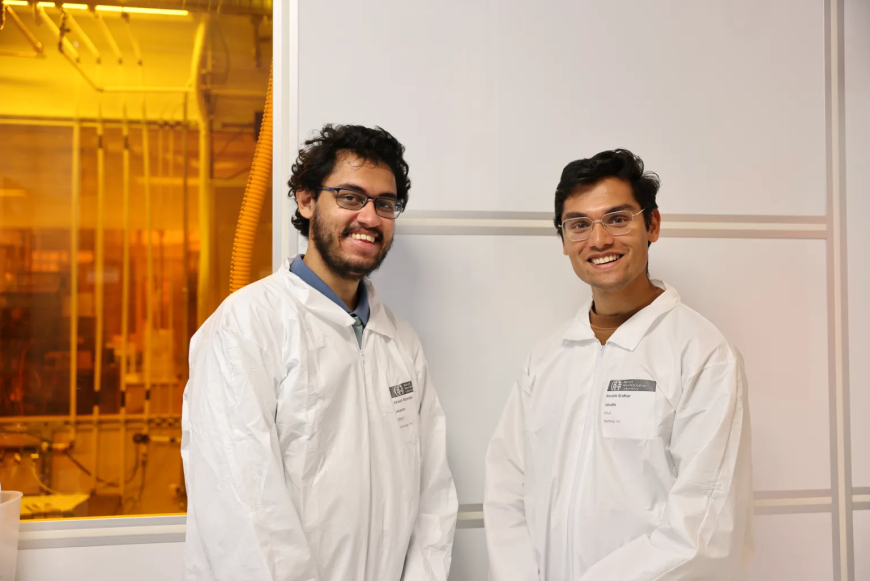
Discovered Materials is using artificial intelligence to search for new semiconductor materials that could help chips run cooler and more efficiently, potentially reducing some of the enormous energy demands associated with AI infrastructure.
The startup recently raised $9 million in seed funding led by Lightspeed India Partners after emerging from Y Combinator. Peak XV Partners also participated, alongside angel investors including Paul Graham, Gokul Rajaram and Thariq Shihipar.
Advaith Sridhar and Akash Ramdas founded discovered Materials. Ramdas earned a doctorate in materials science from Stanford, while Sridhar previously worked on AI agents at Persona AI and Luma Labs.
AI agents search thousands of materials.
The company has developed a software pipeline that uses Anthropic models inside a custom system to generate potential new materials. It then uses foundational physics models trained by the startup to simulate those candidates and determine whether their properties make them worth further investigation.
Sridhar said Ramdas might have generated around 20 material guesses per day while completing his doctorate. Discovered Materials can now explore thousands of possibilities daily by running AI agents continuously in the cloud.
The startup has released examples of hundreds of newly identified materials along with its Material Discovery Bench, which is designed to measure how frontier AI models perform on materials discovery problems.
Other companies, including MatNex, SandboxAQ and CuspAI, are also applying AI to materials research. Discovered Materials is taking a more focused approach by concentrating on the thermal challenges associated with semiconductors.
The company says it has already identified several materials with properties comparable to materials currently used by major chipmakers, although it has not disclosed details about those candidates.
Finding a material is only part of the challenge
One of the greatest difficulties is balancing different properties. A material that improves heat dissipation might be difficult to manufacture at scale, while another candidate could perform well thermally but have unsuitable electrical characteristics.
Lightspeed partner Hemant Mohapatra described the process as playing “whack-a-mole with atomic structures,” because multiple requirements must come together before a material becomes commercially useful.
Mohapatra expects predicting new materials to become increasingly commoditised as AI models improve. He believes Discovered Materials could differentiate itself through Ramdas’ materials expertise and its ability to validate promising candidates in a laboratory experimentally.
The founders say they have already used lab work to validate several materials generated through their discovery process.
Discovered Materials plans to license discoveries
If the company identifies commercially valuable candidates, Sridhar said it plans to seek patents covering their use in GPUs or the manufacturing processes required to produce chips using those materials. The technology could then be licensed to semiconductor manufacturers.
Sridhar hopes the startup will identify materials worth patenting within the next year.
AI-assisted materials discovery remains an emerging field, however. Researchers have identified promising drugs and materials using AI, but few have yet reached widespread commercial deployment.
Examples include MatNex’s work on rare-earth-free permanent magnets and semiconductor materials developed through research involving Panasonic and Citrine Informatics. In pharmaceuticals, Insilico Medicine’s Renterosib has advanced into a Phase II clinical trial after being discovered with generative AI.
Mohapatra said generating additional candidates may no longer be the biggest obstacle. Instead, the difficult part is correctly filtering promising materials and successfully synthesising them in the physical world.
Sridhar similarly acknowledged that AI cannot eliminate every bottleneck. Even with models generating thousands of possibilities, researchers ultimately need to enter laboratories, manufacture the materials and test whether they work as predicted.
That physical experimentation, he said, remains a process that cannot simply be accelerated by adding more AI computing power.
What's Your Reaction?
 Like
0
Like
0
 Dislike
0
Dislike
0
 Love
0
Love
0
 Funny
0
Funny
0
 Angry
0
Angry
0
 Sad
0
Sad
0
 Wow
0
Wow
0