






































Tesla Begins Semi Customer Deliveries After Years of Delays
Tesla starts customer deliveries of its Semi electric truck after years of delays, with a 500-mile range and plans to build up to 50,000 trucks annually.
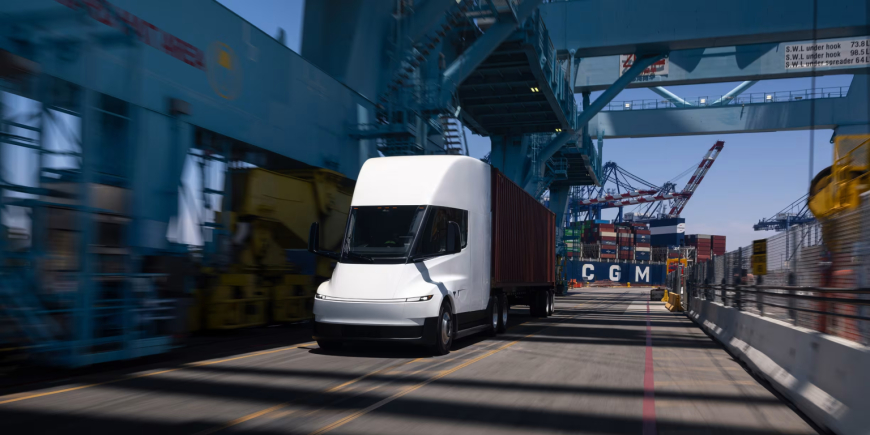
Tesla has begun handing over its long-delayed Semi electric trucks to customers, nearly a decade after first unveiling the heavy-duty vehicle in 2017.
Executives detailed the production version of the truck during a Tesla Semi event in Reno, Nevada, where the company has built a dedicated factory next to its first Gigafactory. Customers can take delivery when they are ready, although charging infrastructure remains a constraint for some operators.
Tesla has not disclosed the Semi’s final sticker price. The longest-range version is expected to travel at least 500 miles on a charge, depending on load, and cost just under $300,000 before incentives. Shorter-range versions are also planned.
The company says the Reno plant could eventually produce as many as 50,000 trucks a year, or roughly 1,000 per week, while supporting about 3,000 jobs.
Tesla reworked the Semi after years of delays.
The Semi was originally expected to enter production in 2019, but the pandemic, parts and semiconductor shortages, and design changes based on feedback from pilot customers delayed its rollouts.
Dan Priestley, who leads Tesla’s Semi program, and engineering executive Lars Moravy said the production truck is about 1,000 pounds lighter than the original version. Tesla also simplified parts of the drivetrain, including redesigning an axle that previously required three different oils so it now uses one.
Charging was another focus of the presentation. During the roughly 30-minute event, Tesla demonstrated a Semi charging from 3% to 60% using one of its megawatt charging stations. The company is also developing a network of those high-power chargers for commercial trucks.
Tesla admits its original window design fell short
One of the most visible changes involves the Semi’s side windows. Earlier versions used pop-out windows that didn’t fully open, an issue truck drivers and automotive publications previously criticised.
The production model now uses conventional roll-down windows. Priestley acknowledged that the previous design was inadequate because drivers need direct access to toll booths, badge readers, call boxes and other roadside infrastructure.
“We fully admit we were wrong about the windows,” Priestley said.
500-mile range remains central to the Semi
Tesla continues to stand behind one of the Semi’s most debated original targets: roughly 500 miles of range while carrying a full load.
Priestley said improving efficiency creates a compounding benefit because a more efficient truck can perform the same work with less battery capacity, reducing both vehicle weight and cost.
Tesla is pitching those efficiencies as part of a broader effort to lower fleet operating costs while reducing trucking emissions. Priestley said heavy trucks account for 16% of emissions despite representing about 1% of vehicles on the road.
The Semi is also expected to gain Tesla’s partial automation features in the future. For now, the company’s immediate challenge is scaling production and charging infrastructure after years spent refining the truck for commercial use.
What's Your Reaction?
 Like
0
Like
0
 Dislike
0
Dislike
0
 Love
0
Love
0
 Funny
0
Funny
0
 Angry
0
Angry
0
 Sad
0
Sad
0
 Wow
0
Wow
0