

































Fake Tech Is Getting Shockingly Convincing
Counterfeit phones, headphones, chargers and other electronics are becoming harder to identify by appearance alone. Here is why fake tech can hide serious performance, safety and cybersecurity risks.
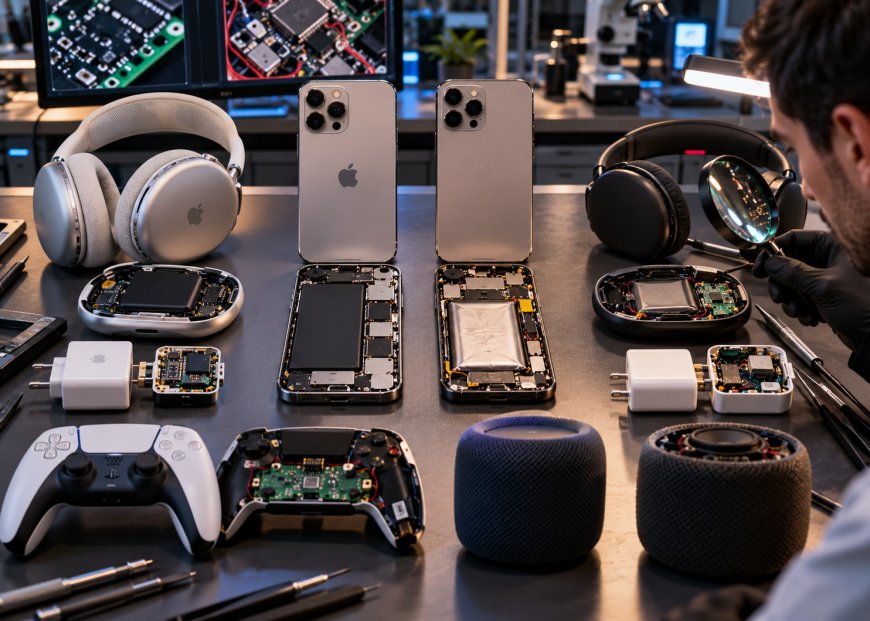
The hardest part of spotting fake technology isn’t the logo anymore.
A counterfeit flagship phone can arrive in packaging that closely mimics the real product, boot with familiar wallpaper and reproduce enough of the interface to survive a quick inspection. Cheap headphones imitate premium industrial design. Speakers borrow recognizable silhouettes. Even accessories such as chargers and controllers can look convincing enough that the price becomes the only obvious warning.
That matters because premium consumer technology has never been more expensive. Samsung still lists the Galaxy S25 Ultra from $1,299.99 in the United States, while Apple’s AirPods Max remain $549. When a visually similar product appears online for a fraction of that amount, the temptation is obvious.
A recent hands-on comparison pushed that question unusually far by testing lookalike phones, speakers, tablets, headphones, home appliances and gaming accessories against the products they imitate. Some of the cheap alternatives were surprisingly competent. Others demonstrated why judging electronics by appearance is becoming increasingly risky.
A Fake Phone Can Look Right While Being Wrong Almost Everywhere Else
The most revealing example was a roughly $300 phone designed to resemble Samsung’s Galaxy S25 Ultra.
From the outside, the resemblance was strong. The packaging copied Samsung’s visual language, the phone booted into a Samsung-like interface, and even recreated features associated with the S Pen. At first glance, the device appeared far more polished than the stereotypical counterfeit phone.
That illusion weakened quickly once the testing moved beyond the home screen.
Apps loaded slowly, gaming exposed weak storage performance and camera quality fell well behind the real Galaxy. The seller reportedly advertised a 6,800mAh battery, larger than the genuine S25 Ultra’s 5,000mAh capacity, yet after an hour of the same gaming workload, the genuine Samsung reportedly retained 86% charge. In comparison, le the imitation fell to 32%.
The fake tablet went further in the same experiment. Its software reported 1TB of storage, but a separate storage-analysis application identified only 32GB of actual capacity. The interface wasn’t simply copying Apple’s visual language; it was presenting hardware specifications that didn’t exist.
That difference is crucial. A cheap product can be a legitimate compromise. A device that intentionally misrepresents its storage, camera or other specifications is something else entirely.
Counterfeit Electronics Carry Risks That a Short Review Cannot Measure
Performance is only part of the problem.
The U.S. Consumer Product Safety Commission has warned for years that counterfeit electrical products can omit safety components or use inadequate wiring and circuitry, creating risks of overheating, electric shock, fire or explosion. In May 2026, the agency launched a new enforcement push specifically targeting fake safety labels and counterfeit certification marks being used to make noncompliant products appear legitimate.
That is particularly relevant to counterfeit chargers and batteries. A charger can deliver approximately the advertised wattage during a quick test and still lack proper thermal protection, isolation or fault handling. Earlier CPSC investigations have found counterfeit phone batteries without circuitry designed to prevent overcharging, creating fire and burn hazards.
Cybersecurity creates another layer of uncertainty. The OECD has documented counterfeit mobile phones as a category in which privacy risks can include preinstalled malicious software, alongside the more familiar quality and safety concerns.
Those problems are difficult to identify in a 20-minute comparison. A device can sound good, charge quickly and survive a drop while still being a poor long-term purchase because its software updates, data practices, battery protections and certification history are unknown.
The global market for such products is also much larger than an occasional suspicious marketplace listing might suggest. The OECD and EUIPO estimated international trade in counterfeit and pirated goods at $467 billion in 2021, equal to about 2.3% of global imports. Electronics are among the industries affected.
Cheap Alternatives Are Not the Same as Fakes
The comparison becomes more interesting when the product is merely inspired by an expensive rival rather than pretending to be it.
One of the strongest performers in the source experiment was Govee’s Floor Lamp 2, compared with a premium Philips Hue floor lamp. Calling the Govee product a “fake” is misleading. Govee is an established smart-lighting company that sells products under its own name, with its own app, warranty, and product ecosystem. Its Floor Lamp 2 officially supports Matter, customizable lighting zones, music synchronization, and app-based scene controls.
In the hands-on comparison, the Govee lamp appeared brighter in some settings and offered more granular effects and customization at a substantially lower price. The reviewer ultimately preferred it.
That is not counterfeiting. It is competition.
The distinction matters because some premium categories are vulnerable to cheaper rivals precisely because the core technology has matured. RGB LEDs, Bluetooth radios, commodity sensors and basic electric motors are no longer exotic components. A smaller company can sometimes deliver most of the visible functionality at a lower price without pretending someone else made its product.
The same principle appeared in the speaker comparison. Harman Kardon sells the Aura Studio 4 for $299.95, with its transparent dome, lighting effects and six-speaker array forming much of its identity. A much cheaper speaker with a remarkably similar design reportedly sounded competitive in one subjective test and even included a battery, something the Aura Studio 4 lacks.
That doesn’t mean the cheaper product will match Harman Kardon in durability, tuning consistency, or support. It does show why premium brands increasingly have to justify more than physical appearance.
Complexity Is Where the Genuine Product Usually Pulls Away
The pattern across the tests was fairly consistent. Simple products were easier to imitate convincingly than complicated ones.
A vacuum cleaner only has to move air effectively enough to collect dirt. A lamp has to produce light and respond reliably to commands. A Bluetooth speaker can make a strong first impression if its amplifier and drivers are reasonably competent.
A modern flagship smartphone has a much harder job. It combines an advanced processor, secure operating system, cameras, display calibration, battery management, cellular radios, biometric security, years of software support and dozens of tightly integrated sensors. Recreating the outer shell is dramatically easier than reproducing that engineering.
The same problem emerged with the fake video doorbell. It looked plausible and included basic smart-camera functionality. Still, its field of view and frame rate were substantially worse than the genuine Ring product in the test, undermining the security purpose for which someone would buy the device in the first place.
The counterfeit AirPods Max also managed to approximate Apple’s appearance while falling apart in ergonomics and construction. The cushions, materials and ear-cup geometry reportedly felt substantially worse even though the reviewer found the audio less disastrous than expected.
That is where copying reaches its limit. Industrial design can be photographed, measured and reproduced. The invisible engineering underneath it is far harder to duplicate cheaply.
The Better Question Is Not “Real or Fake?”
The most useful lesson from counterfeit technology is not that premium products are always worth their price. They are not.
Some established brands charge heavily for design, ecosystem integration and reputation. Legitimate competitors can sometimes provide a better product for less money, particularly in mature categories such as lighting, speakers and accessories. Consumers should absolutely compare them.
The line should be drawn at deception.
A product sold under its own brand with honest specifications is a competitor, even when a market leader clearly influenced its appearance. A device that copies branding, falsifies capacity, misrepresents hardware, or tries to convince a buyer it is an official product introduces risks that a quick value comparison cannot measure.
Counterfeit technology is getting much better at passing the first inspection. That does not necessarily mean the products themselves are getting better.
It means consumers increasingly have to look past the easiest part to copy.
What's Your Reaction?
 Like
0
Like
0
 Dislike
0
Dislike
0
 Love
0
Love
0
 Funny
0
Funny
0
 Angry
0
Angry
0
 Sad
0
Sad
0
 Wow
0
Wow
0